Best Composting Toilets for RVs, Cabins and Tiny Homes
The best composting toilet is the one that fits how you will use it: a weekend cabin, a full-time RV or a tiny house. Most of the choice comes down to how often you are willing to empty it.
The complaint that comes up most in long-term composting toilet reviews is not smell. It is the urine bottle. Two adults living with one full time fill it far faster than the box suggests, and the toilet that suits a weekend cabin can turn into a daily chore in a full-time RV. So picking the best composting toilet comes down to two questions: where does the urine go, and how often are you willing to empty things?
Smell, the thing most buyers worry about, mostly takes care of itself on a vented unit that keeps urine and solids apart. And none of these toilets makes finished compost. They separate, dry and store. The solids still need many months in a separate pile, away from your kitchen-scrap compost and the vegetable beds; a closed bin from our picks for the best outdoor compost bin keeps that pile contained.
Quick answer: Full-time RV, van or boat? Get the Nature’s Head.
Cabin or tiny home where urine can drain away? Get the Separett Villa.
Weekend trips and a tight budget? Get the OGO NOMAD.
Best Composting Toilets at a Glance
Three of the five picks are fixed installs with a fan and a vent hose. Two are portable and need no power at all. The Setup column says more about daily life with each toilet than the rating does.
| Model | Rating | Best For | Setup | Link |
|---|---|---|---|---|
| Nature’s Head Self-Contained Composting Toilet | 4.5★ (1,116) | Best Overall | Fixed, hand crank, 12V fan | Check Price on Amazon → |
| Separett Villa Urine-Separating Toilet | 4.5★ (353) | Best for Cabins | Fixed, fan, urine to drain | Check Price on Amazon → |
| OGO Origin Compact Composting Toilet | 4.1★ (144) | Best for Vans | Fixed, 12V electric agitator | Check Price on Amazon → |
| OGO NOMAD Self-Contained Composting Toilet | 4.1★ (132) | Budget Pick | Portable, no power | Check Price on Amazon → |
| BOXIO Toilet MAX+ Complete Set | 4.2★ (630) | Best Portable | Portable, no power | Check Price on Amazon → |
Ratings and review counts are from Amazon US, checked on October 19, 2026.
How to Choose a Composting Toilet for an RV, Cabin or Tiny Home
Three questions about your space settle most of the choice.
Where will the urine go?
This is the biggest fork. On the Nature’s Head, both OGO models and the BOXIO, urine runs into a bottle you lift out and carry. A self-contained composting toilet works anywhere, from a camper van to a sailboat, but you are the plumbing. On a Nature’s Head, owners of two report emptying the bottle anywhere from daily to weekly, depending on how much of the day they spend at home.
The Separett Villa takes another route. It is a urine diverting toilet that sends liquid down a hose to a drain, a greywater line or a soakaway, so there is no bottle at all. That makes it the natural composting toilet for cabin or tiny house use on land.
Crank, motor or layers?
The Nature’s Head mixes the solids with a hand crank. The OGO Origin uses a 12V push-button motor, and that motor’s drive gear is the most common complaint in its long-term reviews. The Separett, NOMAD and BOXIO have no agitator: you cover each deposit with a scoop of coconut coir, peat moss or sawdust. Fewer moving parts, more scooping.
Fixed install or grab-and-go?
A fixed unit needs a vent hose out through a wall, floor or roof, plus power for its fan. For a composting toilet for RV use, that usually means a hole in the shell and a run of 12V wire. In return, the fan pulls odor outside around the clock. Portable models like the NOMAD and BOXIO need no hose, wiring or tools, but without a fan, smell control rests entirely on the cover material.
The Best Composting Toilets, Reviewed
Every pick had a live Amazon US listing with a buy box for delivery to New York on October 19, 2026. The cons come from complaints that repeat in 1 and 2-star reviews, each with the fix owners use.
Nature’s Head Self-Contained Composting Toilet: Best Overall
Best Overall

The Nature’s Head is the only composting toilet on Amazon with more than 1,000 ratings, and it holds a 4.5-star average. Reviews go back to 2014, and many come from owners who have lived with one full time for years. It is sealed and self-contained, which is why it is our pick for anything that moves.
Long-term owners keep returning to one point: when a part wears out, the maker sends a replacement. For two people, owners report emptying the solids every two to five weeks, depending on toilet paper and cover material. The same listing also offers a foot-spider handle version, so pick the handle style you prefer when you order.
What we like:
- The deepest owner record of any composting toilet on Amazon: 4.5★ from 1,116 ratings
- Fully self-contained, so it needs no plumbing and fits RVs, vans and boats
- Hand crank, so there is no agitator motor to burn out
- A 5-year warranty on the listing, and long-term owners report the maker ships parts
What to watch for:
- The urine bottle fills fast for two adults. On full-time use, plan to empty it daily, or keep a spare bottle (see the supplies section) to swap in.
- After years of use the spider handle is the part that wears: one van owner had the rods break at the welds after three years. Nature’s Head sells replacement parts.
⭐⭐⭐⭐⭐ “We bought our Natures Head on May 29, 2014 and it has been in nearly continuous use by two people since that time.”: Verified Amazon purchase, owned since May 2014 (review from November 2018)
Our verdict: The best composting toilet for a full-time RV, van or boat. It has the longest track record here, and the maker still backs it with parts years later.
Separett Villa Urine-Separating Toilet: Best for Cabins
Best for Cabins
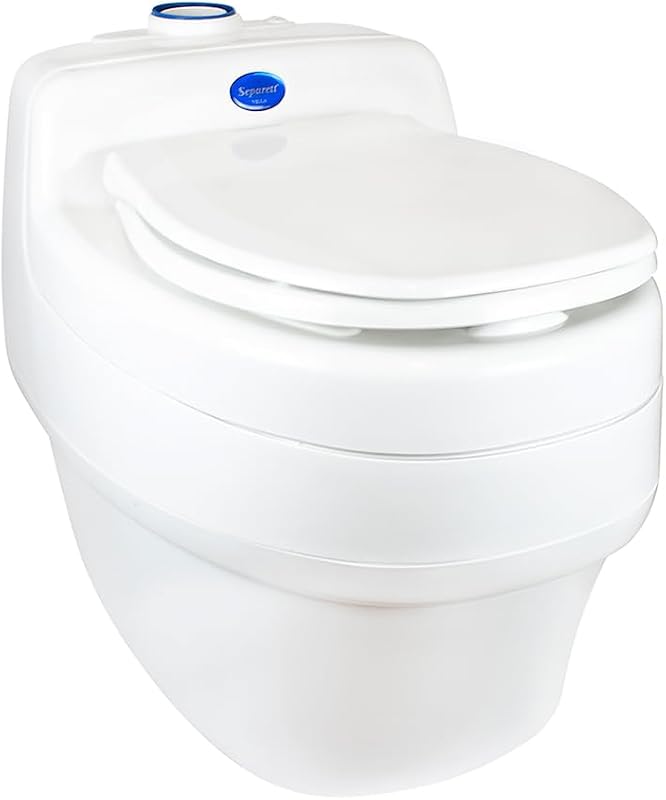
The Separett Villa matches the Nature’s Head at 4.5 stars but is built for a different life. Urine runs down a hose to a drain, a greywater line or a soakaway, so the only thing you ever empty is the solids container. For a cabin or tiny home on its own land, that removes the chore bottle owners complain about most.
It sits at standard toilet height and looks like an ordinary bathroom fixture. There is no agitator: a little cover material and the fan do the drying. Tiny-house and cabin owners with one to two years of use report no odor as long as the fan runs, and quick cleaning.
What we like:
- No urine bottle to carry once it is plumbed to a drain
- Standard toilet height, so it feels like a normal toilet
- Owners with up to two years of use report no odor while the fan runs
- A 4.5★ average with reviews going back to 2014
What to watch for:
- The urine line can clog with crystallized urine after about a year. Flush it with warm water and clean the trap on a schedule, as long-term owners do.
- Vent and drain fittings are metric. Buy US adapters before install day, not during it.
⭐⭐⭐⭐⭐ “I’ve been living in a tiny house with a Separett toilet for 2 years now.”: Verified Amazon purchase, 2 years of ownership
Our verdict: The pick for a cabin or tiny home where urine can drain away. You trade a one-time plumbing job for never carrying a bottle again.
OGO Origin Compact Composting Toilet: Best for Vans
Best for Vans

Space decides this one. OGO lists a 15 by 16-inch footprint with no side crank, the smallest of the fixed units here. One travel-trailer owner says the swap gave more leg room than the original toilet.
A 12V motor stirs the solids at the press of a button. OGO rates the solids bin at 25 to 30 uses and lists a 2.4-gallon urine bottle; a few owners get fewer uses before emptying, so treat the rating as a best case. Several owners run it without the vent hose and report no smell. On grid power, order a 110V adapter with it: none comes in the box.
What we like:
- The smallest footprint of the fixed units on this list, with no side crank
- Push-button agitator, no cranking
- Owners report OGO support replaces parts under warranty
- Made in the USA
What to watch for:
- The agitator drive gear is the weak point in long-term reviews. Owners report OGO replaces failed parts under warranty; keep the solids bin from overfilling so the motor is not straining.
- Urine can drip under the sliding trap door. Keep the door closed while urinating and give it a quick wipe after each use.
⭐⭐⭐⭐⭐ “Heavy use with 4 people doing their business as usual posed no issue on our last week long trip.”: Verified Amazon purchase
Our verdict: The composting toilet for a van or a tight travel-trailer bathroom with 12V on board. Push a button instead of turning a crank, in the smallest fixed footprint here.
OGO NOMAD Self-Contained Composting Toilet: Budget Pick
Budget Pick
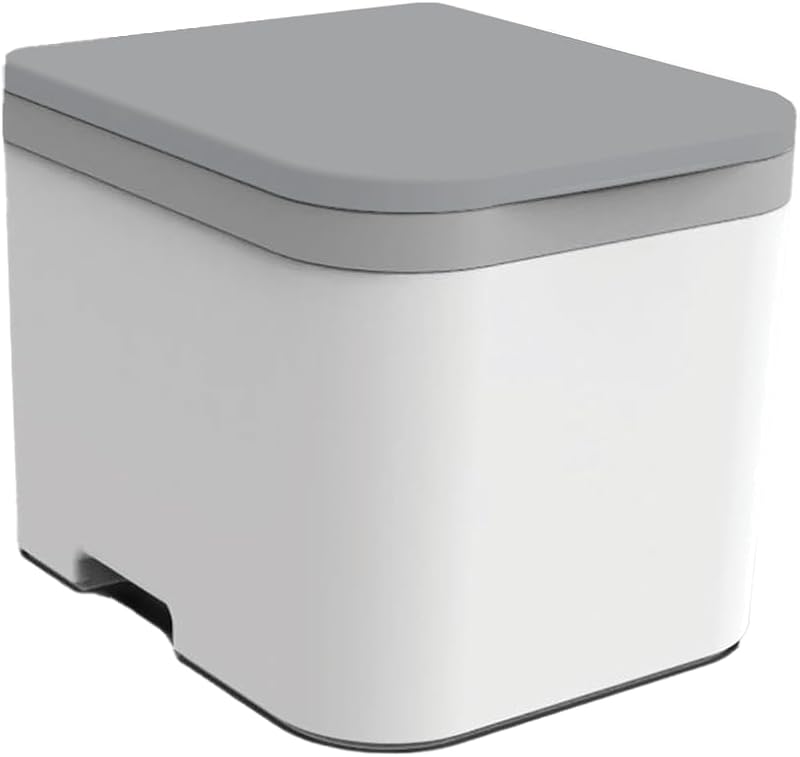
The NOMAD is the composting toilet Amazon buyers choose most: more than 100 sold a month, and the highest-ranked composting toilet in Amazon’s RV Toilets list. It costs about a fifth of the Nature’s Head price. No power, no plumbing, no vent hose to route.
It still keeps urine and solids apart. Solids go into a standard 8-gallon bag you tie off and lift out. Owners call it simple, light and quick to clean, and use it in tiny houses, on boats and as a backup toilet.
What we like:
- About a fifth of the Nature’s Head price
- Nothing to install: no vent hose, wiring or fan
- Standard 8-gallon bags, cheap and easy to find
- The best seller among composting toilets on Amazon
What to watch for:
- The seat is low. One owner raised it a few inches by setting it in a bathtub; a sturdy platform or step does the same.
- A few owners report the base warping after 6 to 12 months of daily use, which lets smell escape. Keep it out of direct sun and hot spots, and check the fit every few months.
⭐⭐⭐⭐⭐ “We have used it almost daily for 10 months with no signs of damage, wear, or breakage.”: Verified Amazon purchase, 10 months of ownership
Our verdict: The cheapest way into a separating toilet that owners actually rate. For weekends, a truck camper or a backup toilet, it does the job without a single tool.
📝 Editor’s note: What comes out of any of these toilets is dried, partly broken-down material, not compost. In a home pile, material that dry barely moves. Decomposition needs moisture, nitrogen and time, and these toilets are designed to take away the first one. Treat the bin contents as a raw input for a dedicated pile that gets wetted, mixed and left for many months, well away from the food garden.
BOXIO Toilet MAX+ Complete Set: Best Portable
Best Portable

BOXIO is a German-made portable separating toilet, and with 630 ratings at 4.2 stars it is the most reviewed portable separating toilet we compared. Full-time RV and van owners report using it for months, and one owner replaced a Nature’s Head with it.
Buy the MAX+ set, not the bare toilet. The set adds a riser and storage base; the base BOXIO without the riser rates lower, 3.8★ (923), and owners find it too low to sit on. BOXIO lists 8 to 10 uses before the 1.5-gallon solids container needs emptying, so full-time users empty it often. Owners like that the smooth shape has no hidden corners to clean.
What we like:
- The most reviewed portable separating toilet here, with 630 ratings
- No power, no hose, nothing to install
- A smooth, simple shape that owners find easy to clean
- Urine canister with a leak-proof plug that owners call easy to empty
What to watch for:
- The clips between the toilet and the riser pop off. One owner holds the clips in place with a cinch strap around the unit.
- The toilet alone sits short. Buy the MAX+ set with the riser, not the base unit.
⭐⭐⭐⭐ “I’m full time RV and been using this thing for several months”: Verified Amazon purchase, several months of ownership
Our verdict: The portable composting toilet with the most owners behind it. Get the MAX+ set, add a strap around the clips, and it moves from van to cabin to boat with you.
Composting Toilets We Don’t Recommend
TRELINO Evo L Composting Toilet: The Evo L holds 3.5 stars from 71 ratings, and only 63% of them are 4 or 5 stars, the lowest share among the composting toilets in our Amazon scan. The 1 and 2-star reviews repeat the same three problems: a lid that does not lock securely onto the body, liquids and solids that mix instead of staying separate, and thin plastic for a toilet that costs more than twice as much as the BOXIO MAX+. We’re not recommending it. Trelino’s smaller Evo S rates better and is not covered by this verdict. If you want a portable unit, the BOXIO MAX+ is the better buy.
Which Composting Toilet Is Right for You?
The Nature’s Head Composting Toilet is sealed, self-contained and backed by more owners than any other composting toilet on Amazon.
The Separett Villa sends urine down a hose, so the only thing you ever empty is the solids container.
The OGO Origin has the smallest fixed footprint here and a push-button agitator instead of a side crank.
The OGO NOMAD is the budget pick that needs no power or plumbing. Want the most reviewed portable instead? Choose the BOXIO MAX+.
Where the Urine and Solids Go
Every owner ends up with two streams to deal with. Plan for both before the toilet arrives.
Urine. On a bottle unit, you carry it out and empty it, usually every day or two with two adults. The common options are an RV dump station or a regular flush toilet, a greywater or soakaway line on your own property (the Separett setup does this through a hose), or diluting it with water and spreading it on a lawn or non-edible plants on your own land. Rules on all three differ by state and county, so check with the local health department before you settle on one.
Solids. There are two routes. The first is bagging them and putting them in the household trash where your local rules allow it; the NOMAD and BOXIO listings both describe bagging the solids for disposal. The second is composting them on your own land in a dedicated pile or closed bin that takes nothing else. That pile needs many months of curing, and the result belongs around trees and ornamentals, never on food crops.
Cover material. For smell, the scoop after each use matters more than the toilet. Coconut coir, peat moss or sawdust soaks up moisture and blocks odor.
Composting Toilet Supplies Worth Having
Four refills keep any of these toilets running: a spare bottle, a cover material and bags for the bag-based units.
| Supply | Rating | Use It For | Link |
|---|---|---|---|
| Nature’s Head spare urine bottle | 4.7★ (141) | Nature’s Head: swap in an empty bottle, empty the full one later | Check Price on Amazon → |
| LEIFIDE coconut coir disks | 4.2★ (103) | Any model: pre-measured cover material, soak and crumble | Check Price on Amazon → |
| Old Potters sphagnum peat moss, 20 qt | 4.5★ (446) | Any model: cover material that goes in dry | Check Price on Amazon → |
| Forid compostable 8-gallon bags, 150 count | 4.5★ (6,960) | OGO NOMAD: standard 8-gallon solids bags | Check Price on Amazon → |
Coir or peat? A Nature’s Head owner with more than a year of use switched from coir to peat because coir got expensive and peat needs no chopping or soaking.
FAQ
Do composting toilets smell?
Not when the toilet is vented and urine stays separate from solids. Most odor complaints in owner reviews trace back to a fan that stopped or a unit installed without a vent; Separett and Nature’s Head owners both describe smell returning when a fan failed. On portable units, a generous scoop of cover material does the fan’s job.
How often do you empty a composting toilet?
Urine: two adults on a bottle unit empty it daily or every few days. Solids: Nature’s Head lists 4 to 6 weeks for two people using it full time, and owners report anywhere from about two to five weeks, depending on toilet paper and cover material. BOXIO lists 8 to 10 uses for its solids container, and OGO rates the Origin’s bin at 25 to 30.
What do you do with the urine from a composting toilet?
Empty it into an RV dump station or flush toilet, run it to a greywater or soakaway line (the Separett setup), or dilute it and spread it on a lawn or non-edible plants on your own land. Rules differ by state and county, so check with your health department first.
Can you put toilet paper in a composting toilet?
Yes, in most models. It fills the solids bin faster, though, and one Nature’s Head owner with four years of use reports that thick, plush paper can bind the crank. Single-ply paper or a small lidded bin for used paper solves it. On a Separett, make sure paper lands in the solids side: paper in the urine bowl can clog the drain line.
Do composting toilets need electricity?
Fixed units do. The Nature’s Head and Separett Villa need power for their vent fans, and the OGO Origin needs 12V for both its fan and its agitator motor; tiny-home owners on grid power have to add an adapter, since none comes in the box. The OGO NOMAD and BOXIO MAX+ need no power at all.
Are composting toilets legal in RVs and cabins?
In RVs and vans, self-contained composting toilets are generally allowed, as long as you dispose of the contents properly. Cabins and tiny homes on land are different. Rules for toilets in a building are set by state and county health codes, and they vary a lot from place to place. Some areas accept a composting toilet in a dwelling, others still ask for a septic or sewer connection alongside it. Call your county health department before installing one.
Nature’s Head or Separett Villa: which is better?
Both hold 4.5 stars, the Nature’s Head from 1,116 ratings and the Separett from 353, so the choice is about where you live. For anything that moves, an RV, van or boat, the Nature’s Head wins: it is sealed and self-contained, with a bottle you carry. For a fixed cabin or tiny home where urine can run to a drain or greywater line, the Separett wins, because you never handle a urine bottle at all.
What is the best cover material: coconut coir, peat moss or sawdust?
All three work. Coconut coir is the most common choice in owner reviews, and it comes compressed, so it stores small but needs soaking. Peat moss costs less, according to an owner who switched to it, and goes in dry, straight from the bag. Sawdust is often free from a woodshop, though one owner found a peat and sawdust mix clumped. Use whichever you can keep dry, and enough to cover every deposit.
Can you use compost from a composting toilet in the garden?
Not straight from the toilet. The solids bin holds dried, partly broken-down material, not finished compost. It needs many months of curing in a separate, dedicated pile. Even then, use it around trees and ornamentals, never on vegetables.
You might also like
Free for beginners
Get the Free Composting Starter Kit
5-day email course + printable guide + our top product picks. Everything you need to start composting confidently.
Get Free AccessNo spam. Unsubscribe any time.