Best Outdoor Compost Bins of 2026: 4 Stationary Picks Compared
Pick the wrong outdoor compost bin and you’ll know it by month two. The pile won’t heat up, the harvest door sticks, or you wake up to find a raccoon has flipped the lid and scattered last night’s scraps across the lawn. The best outdoor compost bin for your yard depends on a question most buyers skip: how much pest pressure does your yard have? It shapes every decision that follows, from the lid to the base to the material.
This guide covers only stationary outdoor compost bins: fixed-position bins that sit in your yard and work passively. If you’re considering a tumbler, see our Best Compost Tumblers guide. Still deciding which composting method suits your setup? Start with Backyard Composting: 3 Methods Compared.
Four bins made the cut, each for a different kind of yard: a four-door enclosed bin that does everything well, a 246-gallon mesh ring for bulk leaves, a low-cost enclosed box that suits first-timers and tight budgets alike, and a cedar composter for gardens where looks matter.
Best Outdoor Compost Bins at a Glance
| Bin | Rating | Best For | Capacity | Link |
|---|---|---|---|---|
| Redmon 65 Gal | 4.5★ (3,071) | Best Overall | 65 gal | Check Price on Amazon → |
| GEOBIN 246 Gal | 4.4★ (5,585) | Best Value | 246 gal | Check Price on Amazon → |
| JupiterForce 80 Gal | 4.3★ (321) | Budget Pick / Beginners | 80 gal | Check Price on Amazon → |
| Greenes Cedar 174 Gal | 4.6★ (362) | Premium Pick | 174 gal | Check Price on Amazon → |
What Actually Makes a Good Outdoor Compost Bin
Three things determine whether an outdoor compost bin works long-term: pest resistance, harvest access, and durability in your climate. Capacity matters, but it’s the least important of the three: you can always add a second bin.
Pest resistance is what most buyers underestimate. Open-design bins work beautifully for yard waste in low-pest environments. The moment you add kitchen scraps, or if your yard has raccoons, squirrels, or rats, the design choice becomes critical. Pest protection comes from three layers, and no single plastic bin on the market gives you all three out of the box. The first is the lid: a latch or clamp that a raccoon can’t simply lift. The second is the base: an open bottom is good for worms, but it’s also a tunnel entrance, which is why a sheet of 1/4-inch hardware cloth under the bin matters as much as the bin itself. The third is the wall: thin plastic and open mesh can be chewed, so food scraps should always be buried in the center of the pile, never left on top.
Not every yard needs all three layers. A pile of leaves and grass clippings attracts almost nothing. A pile with melon rinds and leftover rice attracts everything within a block. Match the protection to what you’re actually putting in the bin.
Harvest access determines how often you’ll actually use finished compost. Side-access doors make harvesting practical without disrupting the active pile above. Bins without them require fully emptying to retrieve compost from the bottom, and most owners who face that chore simply stop harvesting.
Durability in your specific climate (UV resistance, freeze-thaw cycling, heat retention in cold weather) separates a bin that lasts a decade from a two-season bin. Thin plastic warps and cracks in full sun. Wood rots where it touches wet soil unless it’s a naturally resistant species like cedar. Closed plastic walls hold a pile’s heat longer than open mesh in a northern fall, and a large pile holds it longer than a small one.
📝 Editor’s note: Raccoon complaints in compost bin reviews almost never mention the walls. They mention the lid. A raccoon doesn’t chew its way in; it hooks a paw under the edge and pries. That’s why a cheap bungee cord or ratchet strap over the lid fixes most raccoon problems on enclosed plastic bins, while rats and mice are a base problem, solved from below with hardware cloth. If you know which animal you’re dealing with, you know which half of the bin to reinforce.
Redmon 65 Gallon Outdoor Compost Bin with Lift-Off Lid
Best Overall
4.5★ | 3,071 reviews
The highest-rated bin in this roundup at 4.5 stars across 3,071 reviews, and one of the two best-selling stationary bins on Amazon right now, with more than 200 bought every month. What earns it that rating is the four independent side-access doors, one on each face, that let you reach finished compost from any angle without disturbing the active pile above it. No other enclosed bin in this roundup offers this, and it makes a real difference in day-to-day use.
The lift-off lid fits like a trash can lid and stays put in wind, which is a legitimate complaint against many competing bins. Recent owner reviews from 2025 and 2026 confirm both points: assembly in under 15 minutes and a bin that doesn’t blow over once it holds material. Forty ventilation holes on the sides and base keep the pile aerobic without requiring frequent turning. For anyone who wants an enclosed bin without overthinking the decision, this is the default recommendation, and the reason it’s our Best Overall pick.
The one design gap is pests. The lid lifts off by hand, so a determined raccoon can lift it too, and the open bottom gives burrowing animals a way in from below. Both have cheap, permanent fixes: a bungee cord across the lid and a square of hardware cloth under the base. With those two additions, it handles kitchen scraps in most suburban yards.
✓ What we like:
- Four independent harvest doors: the best access design in this roundup
- Highest-rated bin here (4.5★, 3,071 reviews) and 200+ bought every month
- Tool-free assembly in under 15 minutes; lid stays put in wind
- 40 vents on sides and base maintain passive airflow
⚠ What to watch for:
- Lid doesn’t lock: persistent raccoons can lift it, so add a bungee cord in raccoon country
- Open bottom: set it on hardware cloth if rats or voles are active
⭐⭐⭐⭐⭐ “The four doors are genius. I just open whichever side has finished compost and scoop it out without disrupting the rest of the pile. Simple, effective. I’ve had it three years and it’s still solid.”
Verified Amazon purchase, 3 years of ownership
Our verdict: The best all-round outdoor compost bin in this roundup. Four harvest doors, thousands of owner reviews, and proven multi-year durability. If your yard has active raccoons, add a strap over the lid and hardware cloth under the base.
GEOBIN 246 Gallon Composting System
Best Value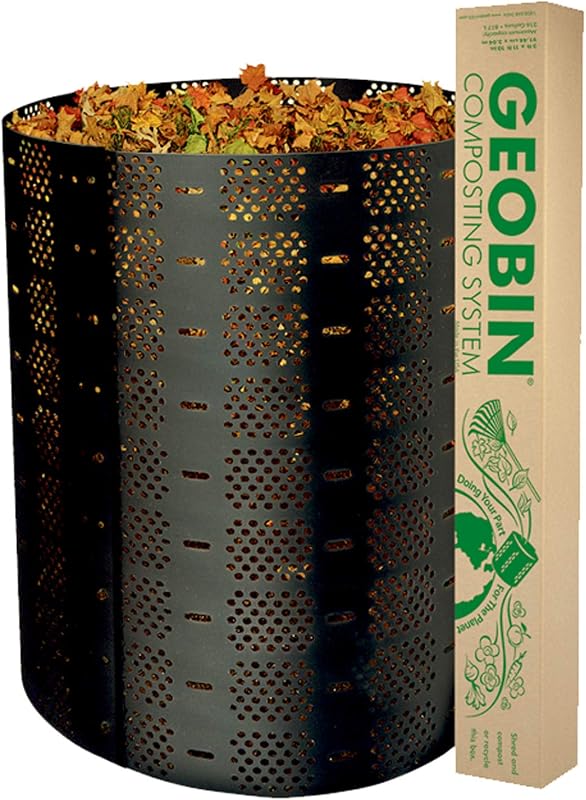
4.4★ | 5,585 reviews
For high-volume yard waste, nothing else in this roundup gives you as much capacity for the money, which is why it’s our Best Value pick. The GEOBIN holds up to 246 gallons, assembles in minutes with interlocking plastic keys, and collapses completely when not in use. It’s also the best-selling stationary bin on Amazon right now, with more than 300 bought every month and 5,585 reviews behind it. Gardeners who generate serious quantities of fall leaves, grass clippings, or seasonal trimmings have relied on it for years.
The open perforated mesh is what makes the GEOBIN work and what limits it. Airflow is exceptional, which accelerates decomposition. Because it’s so light, owners “turn” the pile by unclipping the ring, setting it up next to the heap, and forking the material back in. There’s no lid, no base, and no barrier against animals. Squirrels chew through the HDPE regularly. If you’re composting food scraps or have persistent rodent pressure, this is not the right bin. For pure yard waste in a low-pest environment, it’s hard to beat.
One practical note: current versions no longer include ground stakes, and the bin tips in moderate wind until the pile fills it out. Owners solve it with a few tent stakes or short lengths of rebar driven through the bottom holes on day one.
✓ What we like:
- The most capacity for the money in this roundup: up to 246 gallons in one ring
- Expandable from 112 to 246 gallons; fully portable and collapsible
- No-tool assembly in under 10 minutes
- Outstanding passive airflow speeds up decomposition of yard waste
⚠ What to watch for:
- No pest protection at all: open mesh, no lid, no base
- Stakes not included; bin is unstable when empty or half-full
⭐⭐⭐⭐⭐ “I have three of these set up in my backyard for leaves and garden waste. Each one fills up in fall and I just leave them to break down over winter. By spring I have finished compost with zero effort. For the price, nothing comes close.”
Verified Amazon purchase, 2 years of ownership
Our verdict: The right choice for gardeners with a lot of yard waste, low pest pressure, and a preference for simplicity over structure. For kitchen scraps or any yard with rodent activity, look at the Redmon or the JupiterForce instead.
JupiterForce 80 Gallon Compost Bin
Budget Pick
4.3★ | 321 reviews
If you want an enclosed bin for the lowest possible outlay, or a first bin that forgives a learning curve, start here. The JupiterForce is the cheapest bin in this roundup that still gives you solid walls, a lid, and a harvest door, and the owner response backs it up: 4.3 stars across 321 reviews, more than 100 bought every month, and a spot at #18 in Outdoor Composting Bins. It’s a closed 80-gallon (300 L) box built from BPA-free plastic panels, the fastest-selling style of stationary bin on Amazon this year, and the only one of its kind in this roundup.
Airflow is why it works for beginners. Aeration is the variable new composters most consistently neglect, and insufficient oxygen is the most common reason a pile stalls and smells. Four rows of vents on each side act as a buffer against the usual first-year habit of adding too much nitrogen-rich material and not turning often enough. Mix in plenty of browns and give it an occasional stir, and a kitchen-scrap pile stays aerobic. You load from the top and pull finished compost out through a sliding door at the bottom, so harvesting never means emptying the box. Assembly is tool-free: the panels slot together, and owners keep reporting the same number, about 15 minutes, with the bottom door the only fiddly step. The bin is light when empty, but owner reviews agree it stays put without stakes once it holds a real load of material.
The tradeoffs show up in the lid and the doors. The lid closes over the top but doesn’t snap tight, and some longer-term owners report it warping out of shape within a year of full sun. A raccoon that hooks a paw under the edge can lift it, and so can a strong gust. The fix costs little and lasts: a bungee cord or ratchet strap across the top from day one, which matters most once you start adding kitchen scraps. The second pattern is bottom doors bulging outward when the bin is packed full. Those reports come from the larger 120-gallon size sold on the same listing, but harvesting regularly from the bottom keeps the pressure down on the 80-gallon version too.
Like every plastic bin here, it has no base and sits directly on the ground. That’s good for worms and bad for rats, so set it on 1/4-inch hardware cloth if rodents are active in your yard. No plastic bin is fully rodent-proof, but strap plus hardware cloth closes the two entry points animals actually use. In a cold climate, the closed panels hold more heat than open mesh, and a full bin in a sunny spot keeps working later into fall than a half-empty one.
✓ What we like:
- The lowest outlay in this roundup for an enclosed bin with a lid and a harvest door
- Four vent rows per side keep a beginner’s pile aerobic even with irregular turning
- Tool-free assembly in about 15 minutes, according to owner reviews
- Light to set up, yet stays put without stakes once it’s loaded
⚠ What to watch for:
- Lid closes but doesn’t snap tight and can warp within a year; strap it down
- Bottom doors can bulge when packed full (reported on the 120-gallon size); harvest regularly
⭐⭐⭐⭐⭐ “Easy to put together, took me 15 min. The trickiest part was the door. It seals perfectly. I recommend it 100 percent.”
Verified Amazon purchase, 80 gallon
Our verdict: Our budget pick and the easiest enclosed bin here for a first-timer. You get an 80-gallon closed box, a forgiving vent layout, a sliding bottom harvest door, and a 15-minute setup for the smallest outlay in this roundup. Strap the lid down, don’t overfill it, and set it on hardware cloth if rodents are around.
Greenes Fence Premium Cedar Wood Composter 174 Gallon
Premium Pick
4.6★ | 362 reviews
The only bin in this roundup that looks like it belongs in a garden, and now the best-rated one too, at 4.6 stars across 362 reviews. Greenes uses 3/4-inch thick North American cedar, the same material as their raised bed planters, and the result is a composter that integrates naturally with a formal garden layout. At 174 gallons, the capacity is substantial without overwhelming a smaller yard, and the interlocking slat design makes it easy to expand by adding additional modules over time.
Cedar’s natural oils resist rot and insects without chemical treatment, which matters for a bin that sits in contact with organic material for years. Assembly is tool-free: the boards slide together at the corners. The flip side of that design is that the assembled bin is awkward to move, so pick its permanent spot first and anchor the corners if your ground is soft. The open design (no solid base, gaps between slats) allows excellent airflow and worm access from below. It also means zero pest protection. Squirrels, raccoons, and rats can access this bin easily. If your yard has active pest pressure, this is not a practical choice. For gardens with low pest exposure and an owner who prioritizes aesthetics, it’s the best-looking composting option in this roundup.
✓ What we like:
- The best-looking compost bin in this roundup, integrating with formal gardens
- 3/4″ cedar resists rot and insects naturally, no chemical treatment
- 174-gallon capacity; expandable by adding modules
- Highest rating in this roundup (4.6★); open design allows excellent airflow and natural worm access
⚠ What to watch for:
- No pest protection: open on all sides and base, not suitable for food scraps in pest-active yards
- Cedar weathers faster in humid climates; hard to relocate once assembled
⭐⭐⭐⭐⭐ “Looks so much better than the rusty wire bin I had before. Assembly was simple and the cedar smells great. My neighbors have actually asked me about it. Compost is working well after 6 months.”
Verified Amazon purchase, 6 months of ownership
Our verdict: Our Premium Pick, and the one to choose if aesthetics matter, your yard has low pest pressure, and you want a composter that looks intentional rather than utilitarian.
What We Don’t Recommend
MyLifeUNIT 34 Gallon Compost Bags (2 Pack): These fabric bags sell steadily on Amazon as a cheap entry into outdoor composting, and that’s exactly why we’re flagging them. At 3.9 stars across 475 reviews, only 69% of ratings are four or five stars, the weakest score of any stationary option we considered. The pattern in the low ratings is consistent. The bag doesn’t stand upright until it’s full, so it slumps and folds while you’re still filling it. It leaks fluid from the bottom and seams onto whatever it sits on, which rules out a patio or deck. The top flap is small, which makes adding material awkward, and getting finished compost out of a floppy bag is harder than out of any bin with a door.
The deeper problem is physics. A compost pile heats up because a large mass of material holds the heat its microbes produce. A 34-gallon polyester bag has no walls to hold that heat and no mass to build it, so what you get is slow, cold decomposition at best. Owners who like these bags mostly use them to store leaves for later, and for that job they’re fine. As a compost bin, they’re a storage bag. We’re not recommending them. For a small footprint with real walls, a lid, and a harvest door, the JupiterForce 80 Gallon is the better buy.
Which Outdoor Compost Bin Is Right for You?
GEOBIN 246 Gallon: 246 gallons, collapses flat when empty, made in USA. The best value in this roundup for bulk yard waste.
Redmon 65 Gallon: A bungee strap over the lift-off lid holds against most raccoons; 1/4-inch hardware cloth underneath stops rats from below. No plastic bin is fully rodent-proof, but this setup closes both entry points. The same two fixes work on the JupiterForce if budget is tight.
Redmon 65 Gallon: Four harvest doors, 3,071 reviews, tool-free setup. Our Best Overall pick and the safest choice if you only buy one bin.
JupiterForce 80 Gallon: Four vent rows on every side keep the pile aerobic even with irregular attention, and the bottom door means you never empty the box to harvest. Good for learning the process.
JupiterForce 80 Gallon: The cheapest closed box here, with a bottom harvest door and a 15-minute setup. Add a strap over the lid.
Greenes Fence Cedar 174 Gallon: The only bin here that looks like it belongs. Low pest pressure required.
Helpful Accessories
A good bin takes you most of the way. Two additions solve the problems that most commonly stall an outdoor compost pile:
- Compost aerator: The Compost Crank aerator is a corkscrew of 3/8-inch stainless steel that you twist down into the pile and pull back up, opening air channels to a working depth of 30 inches without turning the whole bin. Oxygen starvation is the most common reason compost piles stall, and an aerator solves it with minimal effort. It’s rated 4.8 stars across 514 reviews, made in Tucson, Arizona, and backed by a lifetime limited warranty. Long-time composters call it the best aerator they’ve used, and it works in dense, wet material where flimsier tools bend. Especially useful for enclosed bins like the Redmon and JupiterForce, where you can’t reach in with a pitchfork.
- Hardware cloth base: For any bin without a solid base (GEOBIN, Greenes Cedar, Redmon, JupiterForce), placing a 1/4-inch hardware cloth mat underneath greatly reduces burrowing animal access. Cut it a few inches wider than the bin, set the bin on top, and let the weight of the pile hold it flat. It’s an inexpensive upgrade that meaningfully improves pest resistance on any open-bottom design, and worms still pass through the mesh.
FAQ
What is the best outdoor compost bin for beginners?
For most first-time composters, the Redmon 65-Gallon or JupiterForce 80-Gallon are the most approachable starting points. Both assemble without tools in minutes, have enclosed sides that reduce odor and deter casual pests, and are compact enough for a standard backyard. The Redmon’s four harvest doors make removing finished compost considerably easier than single-door designs, while the JupiterForce costs less and its four vent rows per side forgive irregular turning.
Do outdoor compost bins attract rats?
Open-design bins will attract rats if you’re adding food scraps. Rats are drawn by the smell of food, not the bin itself. If you’re composting only yard waste, even open bins rarely have serious rodent problems. For food scraps, use an enclosed bin, bury scraps in the center of the pile, and set the bin on 1/4-inch hardware cloth, since rats usually come in from below. A bungee strap over the lid of an enclosed bin like the Redmon or JupiterForce handles raccoons on top. No plastic bin is completely chew-proof against a determined rodent, so the hardware cloth base is the part that does the most work.
How big should my outdoor compost bin be?
The minimum effective size for hot composting is roughly 27 cubic feet. For cold composting, 65 to 100 gallons handles kitchen scraps and light yard waste for most households. If you generate large seasonal volumes (fall leaves, lawn clippings, garden trimmings), the 246-gallon GEOBIN often makes more sense than a smaller enclosed bin. When uncertain, size up: a bin that fills mid-season forces you to stop composting before the harvest.
Should I get a compost bin with or without a bottom?
An open bottom allows earthworms and soil organisms to migrate naturally into your pile, which speeds decomposition and improves compost quality. It also gives burrowing animals a point of entry. If pest pressure is a concern, place 1/4-inch hardware cloth under the bin. Most experienced composters prefer open-bottom designs and manage the pest risk with hardware cloth rather than giving up the soil organism access.
What is better, a compost bin or a compost tumbler?
Tumblers produce compost faster (4 to 8 weeks versus 3 to 12 months for stationary bins) and offer complete pest protection since they’re sealed and elevated. Stationary bins hold more volume, cost less, require no physical effort to turn, and allow natural worm activity. For bulk yard waste composting on a budget, stationary bins are the practical choice. For fast compost from kitchen scraps with zero pest exposure, tumblers win. See our Best Compost Tumblers guide for top tumbler picks.
How long does it take to make compost in an outdoor stationary bin?
Cold composting in a stationary bin typically takes 6 months to 2 years, depending on what you’re adding, how often you turn the pile, and your climate. Active hot composting, maintaining the right heat, moisture, and carbon-to-nitrogen ratio, can produce finished compost in 6 to 8 weeks even in a stationary bin.
Do I need to add worms to my outdoor compost bin?
No. Outdoor stationary bins with open bottoms attract earthworms naturally from the surrounding soil. You don’t need to purchase or add worms. They migrate into the pile when conditions are favorable (warm, moist, rich in organic material) and leave when conditions aren’t. If your bin has a solid base with no ground contact, adding red wigglers can accelerate decomposition, but it’s not necessary for standard cold composting.
Can I use a compost bin in winter?
Yes, but decomposition slows sharply below 50°F (10°C) and nearly stops in open or thin-walled bins. Enclosed plastic bins like the Redmon and JupiterForce hold heat better than open mesh or slatted designs, especially if you fill them full before the first frost. To keep a pile working longer, place the bin in full sun, keep the pile large, and insulate it with a thick layer of leaves or straw packed around and on top. You can keep adding material to any bin through winter; it will simply hold and break down when temperatures rise in spring.
What should I look for in a pest-proof compost bin?
Four features matter most: a latching lid that raccoons and squirrels can’t push open; walls with no gaps large enough for mice; a closed base or hardware cloth underneath to block burrowing; and wall material thick enough to resist chewing. None of the bins in this roundup is fully pest-proof out of the box. The closest setup is the Redmon 65 Gallon with a bungee strap over its lift-off lid and 1/4-inch hardware cloth underneath. The JupiterForce 80 Gallon reaches a similar level with the same two additions. If you need complete pest protection with no add-ons, a sealed, elevated tumbler is the better choice.
You might also like
Free for beginners
Get the Free Composting Starter Kit
5-day email course + printable guide + our top product picks. Everything you need to start composting confidently.
Get Free AccessNo spam. Unsubscribe any time.