Best Compost Tumblers of 2026: 7 Models Worth Your Money
Long-term owner reviews on Amazon tell a consistent story: the tumbler people love in month one is often the one they complain about in month twelve. Screws rust. Doors warp. Plastic clips snap off. And the “ready in 3 weeks!” marketing claim? It almost never holds up in real backyards.
That is the gap we set out to close. We went through long-term owner reviews, Reddit threads in r/composting, YouTube teardown videos, and hands-on reports from gardening forums to separate the tumblers that actually hold up from the ones that just look good on a product page. If you are new to composting, our complete composting guide covers the fundamentals. This article assumes you already know the basics and are ready to pick the right tumbler.
The truth is, most compost tumblers work fine for the first season. The real question is which ones still work well after two or three seasons of sun, rain, and heavy loads. That is exactly what long-term review data reveals, which is why our picks look different from lists that rely on a quick two-week test.
We narrowed the field to seven tumblers that earn their keep across every budget, from a no-frills dual-chamber starter to a fully assembled drum tumbler and an insulated steel line that composts through winter. We also flag one tumbler we specifically do not recommend, with the defect pattern behind that call.
Here is what the data says you should actually buy.
📝 Editor’s note: The single biggest driver of failed batches in a tumbler isn’t the bin. It’s the green-to-brown ratio. A tumbler that smells bad or produces wet, slimy output has almost always been overfed kitchen scraps without enough dry material to balance them. Stop adding greens for a week, add shredded cardboard, turn daily until the smell improves.
Quick Comparison: Our Top Picks at a Glance
This table gives you the highlights. Click any model name to jump straight to its full review below.
| Model | Rating | Best For | Capacity | Link |
|---|---|---|---|---|
| VIVOSUN 43-Gallon | 4.3★ (9,932) | Best Overall | 43 gal (dual) | Check Price on Amazon → |
| Nazhura 43-Gallon | 4.4★ (2,965) | Best Value | 43 gal (dual) | Check Price on Amazon → |
| F2C 43-Gallon | 4.4★ (2,641) | Best Budget | 43 gal (dual) | Check Price on Amazon → |
| Miracle-Gro Dual Chamber | 4.2★ (14,637) | Best Mid-Range | 37 gal (dual) | Check Price on Amazon → |
| Lifetime 60058 | 4.3★ (1,412) | Best Large Capacity | 80 gal (single) | Check Price on Amazon → |
| EZ Compost Wizard Jr. | 4.4★ (748) | Best Fully Assembled | 52 gal (single) | Check Price on Eartheasy → |
| Jora JK Series | 4.1★ (518) | Best Premium | 33 to 106 gal (dual) | Check Price on Eartheasy → |
Our Top 7 Compost Tumblers
VIVOSUN 43-Gallon: Best Overall
Best Overall
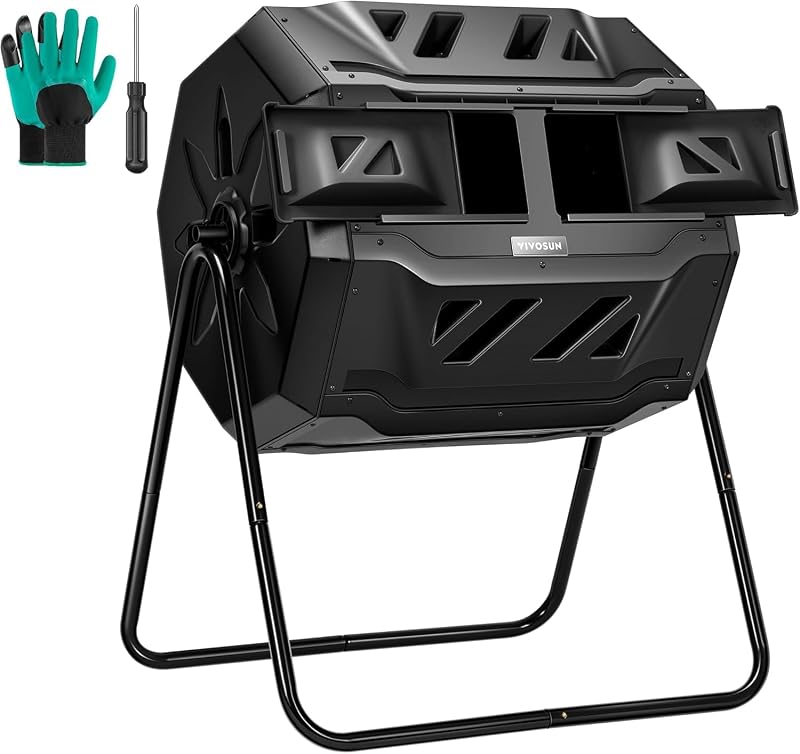
The VIVOSUN 43-Gallon is the best compost tumbler for most people right now, and the numbers behind that call are hard to argue with. It carries close to 10,000 Amazon reviews at 4.3 stars, and it is the best-selling dual-chamber tumbler we found that Amazon itself ships today, with more than 2,000 units bought in a recent month alone. That combination of a deep review history and current sales volume is exactly what we look for in a top pick.
The design is the classic dual-chamber layout done well. Two side-by-side chambers rotate on a galvanized steel frame: you fill one with fresh scraps while the other finishes, so compost keeps coming without a waiting period between batches. In owner comments, the feature that comes up again and again is the deep internal ribbing on all eight panels. Every time you spin the drum, those ribs break up clumps and pull air through the pile far better than smooth-walled drums do.
The dark plastic body absorbs heat well in direct sun, and the drum spins smoothly even when it is loaded. For households of one to three people who want the most proven tumbler they can buy today, the VIVOSUN is the easiest recommendation in this roundup.
What we like:
- The best-selling dual-chamber tumbler we found on Amazon (2,000+ bought in a recent month), backed by 9,900+ reviews
- Deep internal ribs on eight panels break up compacting material and dramatically improve aeration
- Dual-chamber design allows continuous composting without interruption
- Smooth, easy rotation even at higher fill levels
- Dark body retains heat effectively in sunny placement
What to watch for:
- Not watertight: rain seeps in and makes the load heavier and harder to turn. Place it under an overhang or patio cover if possible
- Assembly uses many small screws and nuts. Plan on about an hour with a second pair of hands, and check every part against the manual before you start
“Compared this to the FCMP before buying. Same price, six more gallons, and those ribs inside actually break up the clumps. Three months in and I’m getting great compost.” (Verified Amazon purchase, 3 months of ownership)
Our verdict: The VIVOSUN 43-Gallon is the safest pick for beginners and the best compost tumbler for small to medium households. It combines one of the deepest review histories in the category with the strongest current sales, a proven dual-chamber layout, and internal ribs that do the mixing for you.
Nazhura 43-Gallon: Best Value
Best Value

This one sells under a plain name on Amazon (“Compost Tumbler Bin Composter Dual Chamber 43 Gallon,” made by Nazhura and bundled with Pearson’s gardening gloves), which is why many buyers never notice it. They should. It is one of the top sellers in Amazon’s Outdoor Composting Bins category, with more than 1,000 units bought in a recent month and a 4.4-star rating across nearly 3,000 reviews.
On paper it is very close to our top pick. Amazon lists the same 26.25 x 23.6 x 36.5 inch footprint and the same 43-gallon dual-chamber layout as the VIVOSUN, on a plastic drum with a galvanized steel frame. Owners describe it as well built and good value for money, and the dual chambers give you the same fill-one-while-the-other-cures rhythm. If the VIVOSUN is out of stock or priced higher on the day you shop, this is the model to compare it against.
The trade-off is in the details owners mention most. Assembly takes patience: one reviewer counted 52 small nuts and bolts across 15 parts, and the pictogram instructions leave some steps to guesswork. A few owners also wish the sliding doors were bigger for unloading.
What we like:
- One of the top sellers in Amazon’s Outdoor Composting Bins category, with 1,000+ bought in a recent month
- 4.4-star rating across nearly 3,000 reviews, slightly higher than our Best Overall pick
- 43-gallon dual-chamber design for continuous composting
- Gardening gloves included, handy for loading and unloading
What to watch for:
- Assembly is tedious: about 52 small nuts and bolts, and pictogram-only instructions. Budget an hour and a ratchet or short screwdriver for the tight spots
- The sliding doors are on the small side, so emptying finished compost takes a little longer than with wide-door models
“Better than expected. It’s sturdy. Has alot of screws but I got it put together in under an hour.” (Verified Amazon purchase)
Our verdict: The Nazhura 43-Gallon is the best value compost tumbler right now: one of the category’s top sellers, a 4.4-star rating, and a dual-chamber design that matches our top pick on size. Set aside an hour for assembly and it delivers.
F2C 43-Gallon: Best Budget
Best Budget

The F2C is consistently one of the cheapest dual-chamber tumblers on Amazon, and its 4.4-star rating across 2,600+ reviews proves the price is not the only thing it has going for it. This is the tumbler we recommend to anyone who is not sure whether composting is for them. At this price point, there is almost no financial pressure: try it for a season and decide.
Owners report assembly in about 30 minutes (gloves and a screwdriver are included), and the 43-gallon capacity is generous for the price. One reviewer documented turning 70 pounds of kitchen scraps into usable compost in seven weeks.
What we like:
- One of the lowest prices for a functional dual-chamber tumbler on Amazon
- Quick assembly (about 30 minutes) with included tools, the lowest barrier to entry in the category
- 43-gallon capacity matches tumblers costing twice as much
- Surprisingly effective for the price: owners report finished compost in 6 to 8 weeks during warm months
What to watch for:
- Thin plastic construction will likely not survive more than one to two outdoor seasons. Treat it as a starter tumbler and upgrade once you know composting is for you
- Some buyers receive incomplete hardware kits. Check all parts against the manual before you start assembly, and contact the seller immediately if anything is missing
“…Seven weeks later I had a bucket of the darkest, richest soil I have ever seen. Already planning to upgrade to something bigger next year.” (Verified Amazon purchase, 4 months of ownership)
Our verdict: The F2C 43-Gallon is the best compost tumbler for beginners who want to test the waters without a big investment. It will not last forever, but it does not need to. At this price, it pays for itself with a single batch of finished compost.
Miracle-Gro Dual Chamber: Best Mid-Range
Best Mid-Range

The Miracle-Gro Dual Chamber is one of the most popular compost tumblers on Amazon. It has the largest review count in this roundup, more than 14,600 reviews at 4.2 stars, it ranks among the top three in Amazon’s Outdoor Composting Bins best-seller list, and more than 200 units sell in a typical month. That kind of volume tells you it works for a lot of households, and it is the pick for buyers who want a well-known brand in a compact dual-chamber tumbler.
The layout is the familiar dual-chamber design: two 18.5-gallon chambers (37 gallons total) side by side, each with its own sliding door, so you fill one while the other finishes. The drums sit on a galvanized steel base with side-locking mechanisms that hold each chamber in place while you load it. At 25 x 23.5 x 29.5 inches it has one of the smallest footprints of any dual tumbler here, and owners often mention that it is compact enough not to be an eyesore on a patio or beside a garden bed.
Miracle-Gro is the brand on the box; the tumbler itself is made under license by DF Omer. Owner feedback is more divided than for our top picks. Many reviewers say it works well and was quick to put together, with one owner reporting about 10 minutes of assembly using the online instructions. Others report poor quality control: plastic edges and connectors that crack or come apart, sometimes within the first weeks. The pattern is consistent enough that you should inspect every part when the box arrives and use the return window if anything is cracked.
What we like:
- Largest review base in this roundup: 14,600+ reviews and consistently among Amazon’s top-selling compost tumblers
- Dual 18.5-gallon chambers with separate sliding doors for continuous composting
- Compact 25 x 23.5 x 29.5 inch footprint fits small yards and patios
- Galvanized steel base with side-locking mechanisms holds each chamber steady while loading
- Quick assembly for many owners, with step-by-step instructions available online via a QR code
What to watch for:
- Durability is the recurring complaint: some owners report plastic edges and connectors cracking or coming apart. Check every part on arrival and keep the box until the first batch is done
- At 37 gallons total, it suits one to two people. Larger households should look at the Lifetime 60058 or a Jora JK270 or JK400
“Very good size and structurally sound. Material is high quality and online instructions are very easy to follow.” (Verified Amazon purchase)
Our verdict: The Miracle-Gro Dual Chamber is a solid mid-range choice for small households that want a compact, big-brand dual tumbler with the largest review base on this list. Inspect it carefully when it arrives, and if you want the most durable plastic tumbler for the money, compare it with our VIVOSUN and Nazhura picks above.
Lifetime 60058: Best Large Capacity
Best Large Capacity

If you need serious volume, the Lifetime 60058 delivers 80 gallons (10.7 cubic feet) in a single drum, the largest plastic tumbler in this roundup. It replaces the 100-gallon Lifetime 60309 in this guide, which is now sold only through third-party sellers on Amazon. With 1,400+ reviews at 4.3 stars, the 60058 has the longer and better-rated track record of the two anyway.
The drum uses double-walled HDPE panels that absorb and hold the heat that drives decomposition, on a powder-coated steel frame. An internal mixing bar tumbles the load and lets oxygen flow through it, and the drum turns on a balanced axis, so a full load rotates more easily than its size suggests. Long-term owners describe it as sturdy and well designed, and several report years of regular batches from a single unit.
This is the tumbler for large families, serious gardeners with substantial yard waste, and anyone who has been frustrated by the undersized capacity of budget models. The single 80-gallon chamber gives each batch enough volume to self-heat efficiently. The trade-off is that you work in batches: fill it, let it finish, empty it, then start again.
What we like:
- 80-gallon capacity, the largest plastic tumbler in this roundup
- Double-walled HDPE panels retain heat better than single-wall plastic
- Internal mixing bar and balanced rotation make a heavy load easier to turn
- Long track record: 1,400+ reviews and owners reporting multi-year use
What to watch for:
- Assembly is the hardest in our roundup: you will need a power drill to make holes during assembly and a second person. Budget 2 to 3 hours
- Single chamber means no continuous composting, and some owners find the locking pin that holds the drum in position flimsy. Check it each time you turn the drum
“This unit is very sturdy, well designed and the drum rotation is very easy even with a heavy load.” (Verified Amazon purchase)
Our verdict: The Lifetime 60058 is the best large capacity compost tumbler for households that generate serious volume. The assembly is a chore, but the 80-gallon drum, double-wall construction, and long owner track record make it the go-to choice for large-scale home composting.
EZ Compost Wizard Jr. 7 Cubic Foot: Best Fully Assembled
Best Fully Assembled

The EZ Compost Wizard Jr. solves the single biggest pain point in the tumbler category: assembly. It arrives fully built and ready to use out of the box. No bolts, no drill, no wasted Saturday morning. That alone makes it unique in a market where one to three hours of assembly is the norm.
Instead of the elevated barrel design used by most tumblers on this list, the Compost Wizard Jr. sits on a detachable wheeled base. You roll the entire drum along the ground to mix and aerate the contents, then park it back in place. The 52-gallon single-chamber capacity handles kitchen scraps from two to three people comfortably, and the black recycled polyethylene body absorbs heat well in direct sunlight. A 12-inch twist-off lid on top makes loading easy, and end air vents provide passive aeration between turns.
At 30 x 22 x 23 inches and 30 pounds, it has one of the smallest footprints in our roundup. The BPA-free, FDA-approved recycled plastic and USA manufacturing are strong environmental credentials for buyers who care about sourcing.
The manufacturer claims a 14-day composting cycle. Take that with the same skepticism this article applies to every similar claim: in real backyard conditions, expect six to eight weeks during warm months with a proper green-to-brown ratio. Biology does not speed up just because the marketing copy says it will.
What we like:
- Arrives fully assembled, the only tumbler in our roundup that requires zero setup
- 52-gallon capacity in a compact footprint (30 x 22 x 23 inches), well-suited for small patios and decks
- BPA-free, FDA-approved recycled polyethylene, made in the USA
- Rolling ground-level design eliminates the heavy lifting of elevated barrel tumblers
- Detachable wheeled base doubles as a stand when not turning
What to watch for:
- The rolling mechanism requires flat, open ground to turn effectively. When the drum is full (52 gallons of wet compost is heavy), turning takes real effort and enough clear space to roll it back and forth
- Single chamber means no continuous composting, and owners report hardware on the wheeled base loosening over time. Retighten the bolts every few months
“Unboxed it, set it on my patio, and started composting the same afternoon. No assembly at all. After two months of rolling it every few days, I got my first batch of finished compost. Perfect for my small backyard.” (Verified Amazon purchase, 6 months of ownership)
Our verdict: The EZ Compost Wizard Jr. is the best pick for gardeners who want a no-assembly-required, ground-level tumbler without sacrificing capacity. The rolling design is different from elevated barrel models, so make sure you have the space for it. It sits in the mid-range tier and delivers genuine convenience that no other tumbler on this list can match.
Jora JK Series (JK125, JK270, JK400): Best Premium
Best Premium

The Jora line is the only insulated tumbler in this roundup, and it solves two problems at once: durability and year-round operation. Swedish-designed and built by Joraform, every model uses galvanized steel walls lined with food-grade insulation that, according to the manufacturer, drives internal temperatures above 160 degrees Fahrenheit, even in freezing conditions. The dual-chamber design lets you fill one side while the other cures, so you are never waiting on a single batch.
Jora sells the same design in three sizes, and on Amazon all three share one listing and one review pool (4.1 stars across 518 reviews). Pick the size by how much waste you produce each week:
- JK125 (33 gallons): handles about 2 to 4 gallons of waste per week. Right for one or two people composting kitchen scraps year-round. See the JK125 on Eartheasy.
- JK270 (70 gallons): the middle size for a family that adds some garden trimmings to its kitchen scraps. See the JK270 on Amazon.
- JK400 (106 gallons): 13 to 21 gallons of waste per week, enough for a family of four or five plus seasonal yard waste. At 150 pounds, it needs a permanent, level spot.
Owners consistently say the drum spins smoothly and keeps the compost warm through winter, and they praise the odor control: one described vegetable scraps turning from smelly mush into rich, earthy material. In cold climates where plastic tumblers sit idle for four to five months of the year, a Jora keeps decomposing through winter. This is the most expensive line in the roundup by a wide margin, so it is not a beginner tumbler. It is a long-term investment for households that compost seriously, year-round.
What we like:
- The only insulated tumbler in this roundup: galvanized steel with food-grade insulation keeps composting going in freezing weather
- Three sizes of the same design (33, 70 and 106 gallons), so you can match capacity to your household
- Year-round composting in cold climates where every plastic tumbler on this list slows down or stops
- Galvanized steel body outlasts plastic drums exposed to years of UV
- Side vents keep oxygen flowing for faster, odor-free decomposition
What to watch for:
- The price only makes sense for heavy, year-round composters in cold climates. In a mild climate, one of the plastic models above delivers far better value
- Assembly is heavy work and some owners describe it as a beast to put together. The JK400 weighs 150 pounds and needs multiple people, and alignment is critical for the door seals to work
“We compost all our kitchen scraps plus fall leaves and yard trimmings year-round in upstate New York. The JK400 hit 160 degrees in February. Nothing else we tried came close to this in cold weather. Worth every penny.” (Verified Amazon purchase, 3 years of ownership)
Our verdict: The Jora JK series is the right pick for households in cold climates who want year-round composting and a tumbler built to last. Our pick is the JK400 for households that also compost large amounts of yard waste; the JK125 and JK270 linked above suit smaller households. If your climate is mild or you compost seasonally, one of the plastic models above is the better buy.
Tumblers We Don’t Recommend
Mantis Back Porch ComposTumbler: Not Recommended
Not RecommendedWe researched this tumbler because the Mantis name carries weight with gardeners, and the compact, wheeled design looks ideal for patios and small yards. Unfortunately, the review data tells a clear story: at 3.8 stars, it has the lowest rating of any tumbler we considered, and more than one in five reviews (22 percent) gives it only one or two stars.
The core problem is durability. The complaint pattern in owner reviews is consistent: the handle breaks after a few weeks of use, the plastic on the sides of the barrel comes apart, and compost spills out during turning. Several owners also report poor manufacturing quality on arrival and conclude it is not worth the money. For a small 37-gallon single-chamber unit, those are not acceptable trade-offs when the dual-chamber VIVOSUN and Nazhura models above hold up far better.
Our take: Mantis makes respected garden tools. This tumbler, however, does not live up to the name. If you want a compact tumbler, the F2C 43-Gallon gives you more capacity, two chambers, and a much stronger owner track record.
That said, we link it below so you can read the reviews yourself and make your own call.
What Size Compost Tumbler Do You Actually Need?
This is the most overlooked question in tumbler shopping, and the number one source of buyer regret. In owner reviews, “too small” is the most common complaint from owners of 37-gallon models, especially households of three or more people.
The reason is physics. Compost needs enough volume to generate and retain heat. A minimum internal temperature of around 130 degrees Fahrenheit is required for hot composting, and small tumblers lose heat faster than they can produce it. A 37-gallon tumbler works for one to two people generating kitchen scraps only. Anything beyond that, and you need more capacity than most people realize.
Compost Tumbler Size Calculator
Answer 4 questions → get one specific tumbler for your household.
How to Keep Your Compost Tumbler Rust-Free
Any compost tumbler with exposed metal parts (axles, bolts, hinges) will develop rust if left unprotected. The good news: it is entirely preventable with a few minutes of maintenance per season.
Before first use: Apply a thin coat of marine-grade grease or white lithium grease to any exposed metal: axles, bolts, hinges, and contact points between metal and plastic. This takes 10 minutes and buys you years of rust-free operation. On tumblers with plain steel hardware, such as the Lifetime 60058, swap the stock screws for stainless steel equivalents from any hardware store during assembly.
Placement matters: Position your tumbler where it gets sun (heat accelerates composting) but is protected from direct rain. Under a patio roof, a carport overhang, or a simple tarp canopy are all effective. If full sun is your only option, a fitted cover for the base and hardware will prevent most moisture damage.
Seasonal check (spring and fall): Inspect all bolts for orange discoloration. Re-grease the axle. Check door seals and hinges for cracks. Tighten any hardware that has loosened over winter. For plastic tumblers (VIVOSUN, Nazhura, F2C, Lifetime), check for UV damage (hairline cracks in panels) and replace the unit if structural integrity is compromised.
Winter storage (cold climates, plastic tumblers only): If your tumbler is empty and you live in zones 3 to 5, move it to a garage or shed for winter. Freeze-thaw cycles accelerate plastic degradation. Jora tumblers, being insulated steel, can stay outside year-round.
FAQ
Are compost tumblers worth it?
Yes, for beginners and anyone with a small yard. Tumblers are cleaner than open bins, fully sealed against rodents, and easier to manage. One honest caveat: a 2016 study by Which? Magazine found that tumblers are not actually faster than a well-maintained open bin that gets turned regularly. The convenience advantage is real, but the speed advantage is mostly marketing.
How long does it take to make compost in a tumbler?
Expect 6 to 8 weeks in warm weather (above 70 degrees Fahrenheit) with a proper green-to-brown ratio. In cooler months, 3 to 4 months is more realistic for plastic tumblers. Insulated Jora tumblers can maintain hot composting speeds even in winter. Ignore any claim of “compost in 2 weeks.” That is not how biology works in a home setting.
What size compost tumbler do I need?
For 1 to 2 people with kitchen scraps only, 37 gallons is the minimum. Families of 3 to 4 should start at 65 gallons. Households of 5 or more, or anyone adding yard waste, need 80+ gallons. Undersized tumblers are the number one complaint in Amazon reviews because they cannot generate enough heat for effective hot composting. Use our sizing calculator above for a personalized recommendation.
What is the best ratio of greens to browns in a compost tumbler?
Aim for roughly 2 parts browns (dry leaves, cardboard, shredded paper) to 1 part greens (kitchen scraps, fresh grass) by volume. The moisture level should feel like a wrung-out sponge. If your tumbler smells bad, add more browns. If decomposition seems stalled, add more greens and a splash of water.
Compost tumbler vs compost bin: which is better?
Tumblers win on convenience: they are sealed (no rodents), compact (fit in small yards), and require no pitchfork turning. Open bins win on capacity and cost: you can build one from pallets for nearly nothing. If you have a suburban yard under a quarter acre, a tumbler is the better fit. If you have acreage and generate large volumes of yard waste, a bin or pile is more practical.
Do compost tumblers work in winter?
Plastic tumblers slow down dramatically below 40 degrees Fahrenheit and essentially stop composting in freezing conditions. The Jora JK series (insulated galvanized steel) is the exception: according to the manufacturer it maintains internal temperatures of 160+ degrees Fahrenheit even in sub-zero weather. If you live in USDA zones 3 to 6 and want year-round composting, a Jora is the only insulated option in this roundup. Otherwise, plan to add extra browns in fall and accept slower processing until spring.
How often should I turn my compost tumbler?
Give it 3 to 5 full rotations every 2 to 3 days. That is enough to aerate the material without disrupting the microbial colonies that do the actual decomposing. Over-turning (daily or multiple times a day) can actually slow things down by cooling the pile and breaking up fungal networks. Less is more once you have a good green-to-brown ratio established.
Can I add worms to my compost tumbler?
No. Compost tumblers generate too much heat and mechanical agitation for worms to survive. Red wigglers need stable temperatures between 55 and 77 degrees Fahrenheit and undisturbed bedding. If you want vermicomposting, you need a dedicated worm bin. That is a completely separate system from a tumbler. The two methods complement each other well, but they cannot share the same container.
You might also like
Free for beginners
Get the Free Composting Starter Kit
5-day email course + printable guide + our top product picks. Everything you need to start composting confidently.
Get Free AccessNo spam. Unsubscribe any time.