Composting Toilet Waste Disposal: Urine, Solids and the Law
Composting toilet waste disposal is simpler than it sounds. There are two jobs, emptying the liquids and emptying the solids, and each one has its own schedule.
Buying the toilet is the easy decision. The real question shows up in week two, when the urine bottle is full, the solids bin is getting heavy, and nobody told you where any of it goes. Composting toilet waste disposal comes down to two jobs on two schedules, and one mistake causes most of the trouble: treating what comes out of the solids bin as finished compost. It is not. It is half done, and it still carries pathogens.
If you are still choosing a toilet, see our guide to composting toilets for RVs, cabins and tiny homes. Whether urine runs to a bottle or a drain decides how much of this work lands on you.
Quick answer:
Urine: into a flush toilet or an RV dump station. On your own land, only where local rules allow.
Solids: bag them, then cure them in a separate lidded bin for about a year, or hand them to a licensed septage hauler.
Finished material: under trees, shrubs and ornamentals, never on vegetables.
Two Waste Streams, Two Different Jobs
Most self-contained composting toilets divert urine: liquid runs forward into a bottle, and solids drop into a separate bin with a cover material such as coco coir or peat moss. Keeping them apart is what makes the system work. The Nature’s Head FAQ blames the mix of liquid and solid waste for the off-gassing behind sewage smells. A bin without urine stays drier and smells earthy.
The solids are where the risk sits. The EPA’s fact sheet on composting toilets states the goal plainly: the system exists “to contain, immobilize, or destroy pathogens.” The same fact sheet says a properly sized and maintained toilet reduces waste to 10 to 30% of its original volume, so the bin fills slower than most new owners expect.
In the chart below, the flush toilet and the RV dump station are two options for the urine bottle, not two steps: use whichever is closer.
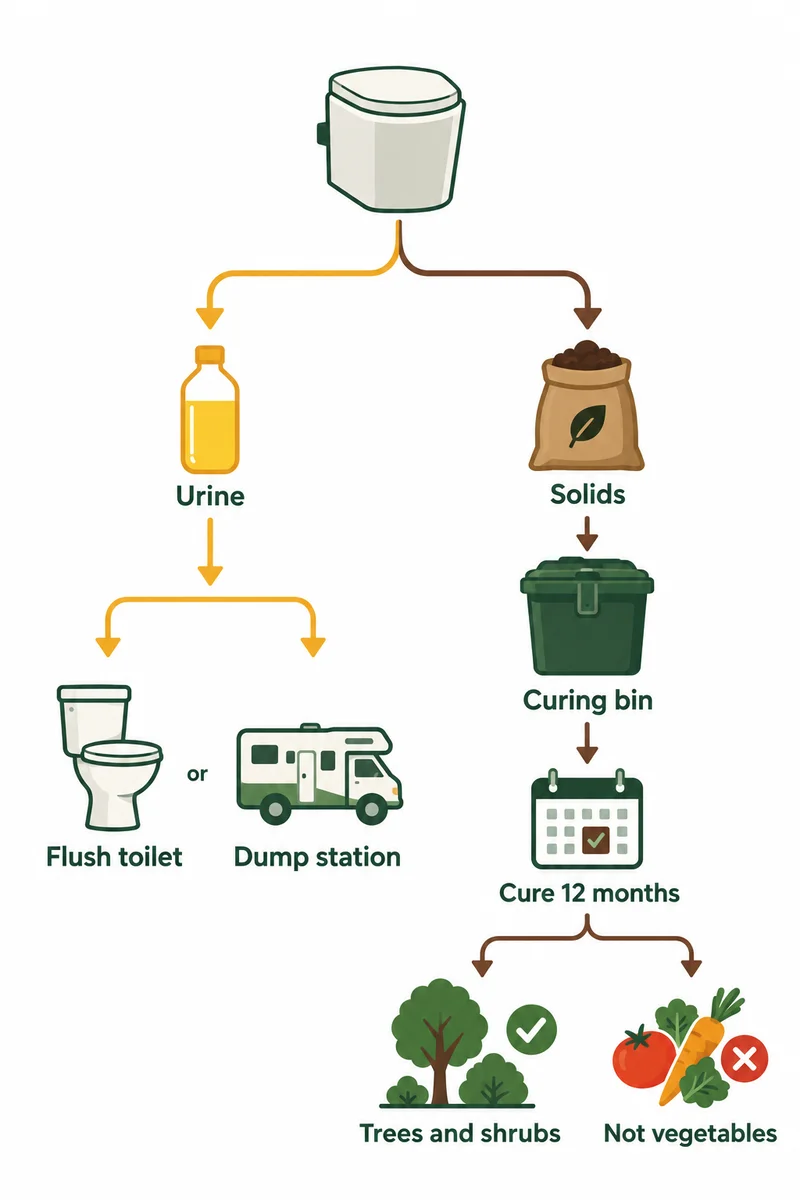
Composting Toilet Urine Disposal: Where It Can Go
On the road (RV, van, boat). A flush toilet or an RV dump station. The Nature’s Head user guide from Australian dealer Zone RV says the bottle can go into a conventional toilet or another appropriate facility. Campgrounds set their own rules, so ask before you pour.
Cabin or land with a septic system. Into that system, if your permit allows it. Massachusetts, under 310 CMR 15.289, bans liquid discharge from the toilet itself. The liquid goes either through a greywater system that includes a septic tank and leaching system, or out with a licensed septage hauler.
Garden use. Where local rules allow it, diluted urine is a nitrogen fertilizer. The Nature’s Head FAQ recommends at least 50% water so it does not harm plants, and names mature trees as a good target. For food crops, the SSWM factsheet on urine storage sets at least one month of storage as the baseline; a family using urine only on its own food crops can skip the storage. Simpler: ornamentals, lawns and trees, not the salad bed.
Never: storm drains, ditches, streams, or anywhere near a well.
Smell is a timing problem. Zone RV’s guide puts the bottle at 2.2 gallons and says two people might need to empty it after 3 to 4 days. Urine smells worse as it sits, so empty early, rinse the bottle, and add a few ounces of white vinegar if a smell lingers.
How to Empty a Composting Toilet Solids Bin
The Nature’s Head FAQ says it is time when the agitator handle gets hard to turn: the bin then holds more waste than compost material. For two full-time users, Zone RV’s guide puts that at about every 3 weeks. Weekend use with two people can stretch it to 2 months or more. On toilets without a crank, empty before the bin is full.
- Wait several hours after the last use. Zone RV’s guide suggests 6 to 8 hours.
- Put on gloves. The newest layer is fresh waste, and the guide recommends gloves for anyone who may touch it.
- Pull a 13-gallon kitchen bag tightly over the opening of the base, invert the base, and let the contents drop into the bag.
- Tie the bag and take it straight to your curing bin, or the disposal route your local rules allow.
- Add fresh cover material before the next use.
Skip the scrubbing. The guide says the material clinging to the sides keeps the composting going, and it warns against cleaning the base with chemicals.
Curing the Solids: Where Composting Actually Happens
What comes out of the bin is not compost yet. Zone RV’s guide says it directly: full-time use “does not allow enough time for the solid wastes to compost,” and the newest layer has barely started. The composting happens after you empty it.
Give it a lidded bin or closed pile of its own, used only for toilet solids, away from the vegetable garden, wells and water. Not your kitchen-scrap pile: that compost goes on food beds, and this one never will. Cover each bag you add with a few inches of carbon: sawdust, coco coir or shredded leaves. The cover keeps flies out, holds smell down and balances the nitrogen, the job browns do in any pile. The basics of a working compost pile all apply.
Then wait. About a year from the last addition is the common guideline, and Zone RV’s guide treats a year of composting as the minimum. Massachusetts goes further and requires systems designed to store solids for at least two years. The practical setup is two bins in rotation: fill one, close it, start the other. By the time the second is full, the first has had its year.
Why so long? Heat kills pathogens fast. EPA’s benchmark for composting sewage sludge is 131°F (55°C) or higher for 3 days in a vessel or static pile, per its Plain English Guide to the Part 503 rule. That rule covers treatment plants, not toilets, and a small toilet-only bin rarely gets there. The EPA fact sheet says as much: in composting toilets, temperatures “typically never become high enough to rapidly destroy pathogens.” Time does the work instead, the same trade-off behind hot and cold compost piles.
When the year is up, check it like any compost: dark, crumbly, smells like soil, no visible paper. The standard readiness tests work here too. If it fails, give it more months.
📝 Editor’s note: A cold bin started in late fall does almost nothing until spring. In our own piles, a batch closed in November looks much the same in March. So a “one year” bin filled in November has really had one summer of work. Count curing time in warm months, not calendar months. With long winters, the Massachusetts two-year figure looks less like caution and more like realism.
Where Finished Toilet Compost Can and Can’t Go
The EPA fact sheet names the right home for it: burying composted human waste “around tree roots and nonedible plants.” Trees, shrubs, ornamental beds, a hedge line. Dig it in or cover it. Massachusetts asks for at least six inches of clean compacted earth over buried residuals.
Keep it off the vegetable garden and away from anything eaten raw. Zone RV’s guide says placing human waste compost “on edible plants or vegetables is not recommended,” and we agree without exception: the payoff is small and the downside is a pathogen you cannot see. And keep it on your own land, not in a neighbor’s tomato bed.
Is It Legal? Composting Toilet Waste Disposal Rules in the US
The federal baseline is one sentence in the EPA fact sheet: the finished humus “legally must be either buried or removed by a licensed septage hauler in accordance with state and local regulations.” The details come from your state and county.
Massachusetts Title 5 shows how specific a state can get: one section covers liquid, two years of solids storage, and burial or a hauler for the residuals. Other states use different codes and agencies, and counties can add permits. That is why we keep no list of “legal states.”
What about the trash? It is the most argued question in RV forums. The Nature’s Head FAQ says that when traveling, the solids “can be disposed of in a bag,” and Zone RV’s guide allows a dumpster only once the contents have composted fully. The EPA names only burial or a licensed hauler. Whether bagged human waste can go in household trash is for your county and trash hauler to answer, not a forum thread. We do not recommend it as the default.
Who to ask:
- Your county or local health department, for permits and burial.
- The campground or RV park, before using their toilets or dump station.
- Your trash hauler, before anything goes in the bin.
FAQ
Can you put composting toilet waste in the trash?
It depends on your county and your trash hauler. The EPA names only burial or a licensed septage hauler for the finished material. Ask before making it a habit.
Can you dump composting toilet waste into a regular toilet?
Urine, yes: a flush toilet or an RV dump station is the standard place for the bottle. Solids go to a curing bin, on-site burial or a licensed hauler instead.
How often do you need to empty a composting toilet?
For two full-time users, a Nature’s Head user guide puts the urine bottle at every 3 to 4 days and the solids bin at about every 3 weeks. Weekend use stretches the solids bin to 2 months or more.
Can you use compost from a composting toilet on a vegetable garden?
No. Use it under trees, shrubs and ornamentals, dug in or covered with soil. The EPA fact sheet points to tree roots and nonedible plants.
Is composting human waste safe?
It is when done slowly and kept away from food. Small toilet bins rarely get hot enough to kill pathogens quickly, so time does the work: about a year in a separate bin, then nonedible plants only.
Where do you dump urine from a composting toilet when camping?
A flush toilet or an RV dump station, after checking the campground’s rules. Never a storm drain or stream.
How long does composting toilet waste take to break down?
Plan on about a year from the last addition, counting warm months. Massachusetts requires systems designed for at least two years of solids storage.
Does a composting toilet smell when you empty it?
The solids bin of a urine-diverting toilet should smell earthy, not like sewage. Urine is the main smell source and worsens as it sits, so empty the bottle often and rinse it.
You might also like
Free for beginners
Get the Free Composting Starter Kit
5-day email course + printable guide + our top product picks. Everything you need to start composting confidently.
Get Free AccessNo spam. Unsubscribe any time.