Four weeks in and the pile looks exactly the same as the day you built it. No heat when you push a hand into the center. No earthy smell. The shredded cardboard on top still reads as shredded cardboard. This is the situation a compost activator is designed to fix, and it is also the situation where most gardeners start buying things they do not actually need.
The honest question is not “should I use a compost activator?” It is “what is actually stopping my pile from breaking down?” Sometimes the answer is a nitrogen source. Sometimes it is a missing microbial community. Sometimes it is moisture or turning, and no product will help. Before anything else, confirm you have the basics of a working pile in place. Then read on.
What Is a Compost Activator?
A compost activator is any substance that kick-starts or speeds decomposition by correcting what the pile lacks. In practice that means one of two things: missing nitrogen, missing microbes, or occasionally both. The word gets used loosely on garden-center shelves, so it helps to separate the category into four distinct types.
Nitrogen-source activators. High-nitrogen organic materials like blood meal, feather meal, and fish hydrolysate. These correct a carbon-to-nitrogen imbalance by handing the microbes the fuel they need to multiply. This is the most common type sold in garden centers and the fastest-acting.
Microbial inoculants. Concentrated cultures of live bacteria and fungi. They work best when the pile lacks microbial diversity, typically a new bin filled with sterile materials. Their effect is less dramatic visually than a nitrogen boost and takes longer to show.
Enzymatic activators. Concentrated cellulose and lignin-degrading enzymes. Most of the published work on these is at commercial composting scale. Independent evidence at backyard volumes is thin.
Humification agents. Biochar, leonardite, humic acid. These are not speed-up tools. They work over months to stabilize humus formation and improve the finished product’s soil-building quality. Different use case entirely.
Most products on garden-center shelves blend types 1 and 2. Reading the label matters.
How They Work: The C:N Ratio
Active composting runs on a carbon-to-nitrogen ratio around 25 to 30 parts carbon per part nitrogen. Below that, the pile goes wet and smelly. Above it, the pile stalls. The typical home-composter’s pile skews heavily toward the stalled end because brown materials are easier to collect.
Here are the numbers in everyday terms. Dry leaves sit at roughly 60:1. Sawdust is 400:1. Cardboard is 500:1. On the nitrogen side, grass clippings are about 15:1, kitchen scraps land near 25:1, and coffee grounds sit around 20:1. A pile of autumn leaves with a handful of kitchen scraps tossed on top is not even close to 30:1. It is drifting into the hundreds.
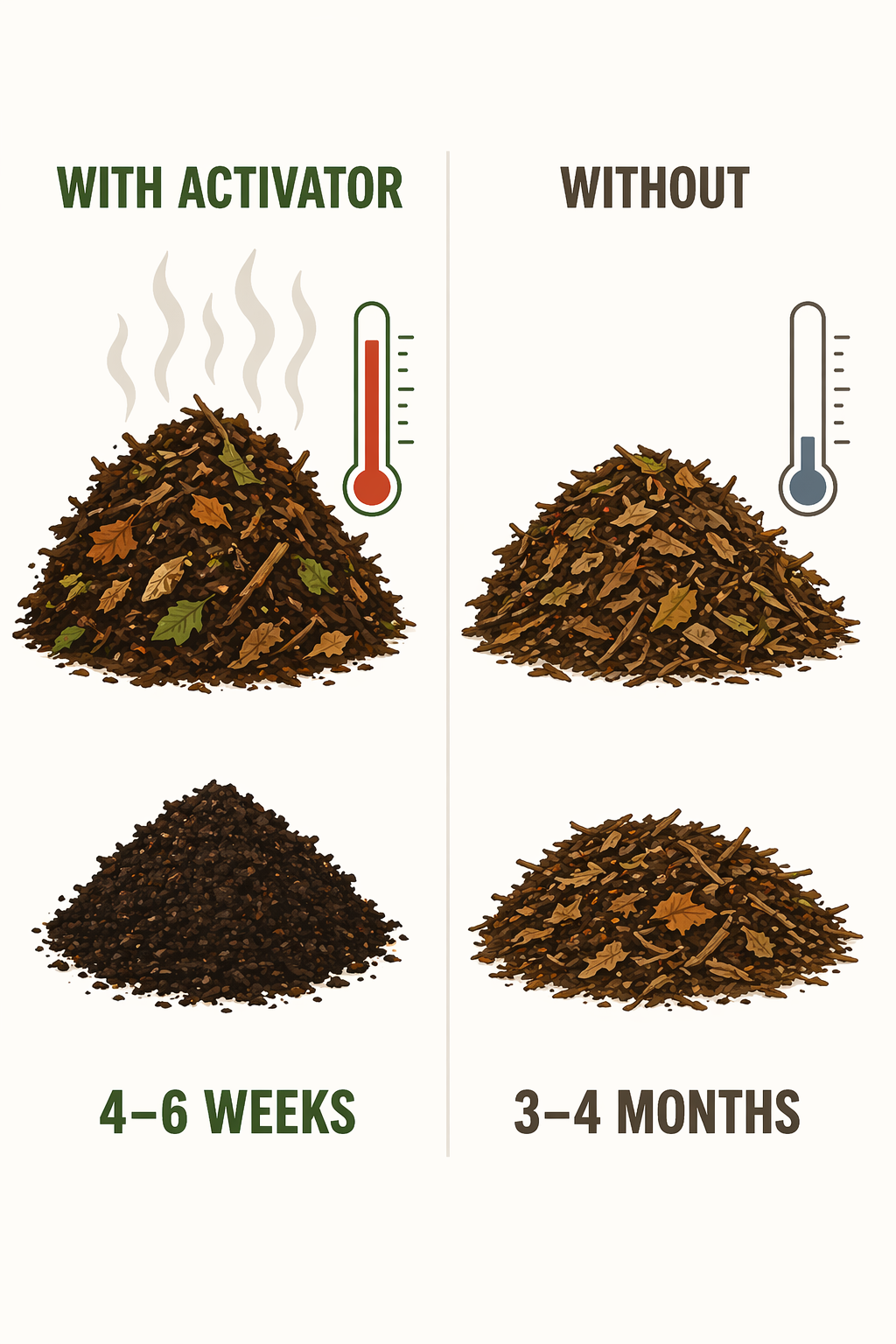
What happens then: the bacteria have mountains of food (carbon) but cannot reproduce without nitrogen. Activity drops to near zero. No heat. No visible breakdown. A nitrogen-source activator corrects this directly. Once nitrogen is available, the thermophilic phase above 130°F (54°C) kicks in within a few days.
Microbial inoculants work on a different problem. They do not fix the ratio. They add the workforce. A pile with balanced C:N but a very small starting microbial population, which is typical of a brand-new bin built from clean purchased materials, responds well to one. A pile already full of diverse soil bacteria will not respond much. A 2024 review in ACS Omega spells out the mechanistic difference between nitrogen-source and microbial-inoculant additives and why each performs differently depending on the starting pile.
📝 Editor’s note: Most people expect heat within 24 hours of adding an activator. In a carbon-heavy pile, the first real temperature climb shows at 48 to 72 hours after nitrogen is introduced, not immediately. If you check at hour 12 and nothing is happening, that is normal. Check again at day three.
Do Compost Activators Actually Work?
Yes, for the right types in the right conditions. No, when the pile already has what it needs. That nuance is where most guides get lazy.
The clearest consumer-side data comes from Which? magazine, the UK consumer testing body, which ran controlled trials of commercial activators. When the pile already had a balanced C:N ratio, the activators produced no measurable speedup. The microbes were not the limiting factor, so adding more of them changed nothing.
Microbial inoculants hold up better when the starting conditions are sterile. A 2025 review in ScienceDirect found consistent peer-reviewed evidence for a faster thermophilic phase when microbial diversity was low at pile startup. The same review noted the effect was minimal in piles that already contained finished compost or a shovel of garden soil.
Enzymatic activators do not have enough independent home-scale evidence to recommend or dismiss. Humification agents like biochar work on a timescale of months to years, so they are irrelevant when the goal is faster decomposition this season.
The practical takeaway: a pile with balanced greens and browns, adequate moisture, and regular turning does not benefit from an activator. Diagnose before buying.
When Your Pile Actually Needs One
Three scenarios account for nearly every case where an activator genuinely helps. If your pile does not match one of them, the activator is not the answer.
Scenario 1: All-browns fall start. The pile is 80 percent or more dry leaves, cardboard, straw, and woody prunings. Two weeks in, no heat. No ammonia smell. The materials look the same as the day you stacked them. This is a classic nitrogen deficiency. Fix it with a nitrogen-source activator, or with one of the free alternatives in the next section. Add, turn, wait 48 to 72 hours for the first temperature climb.
Scenario 2: New bin, sterile materials. Fresh wood-chip mulch, peat, shredded office paper, clean cardboard, no garden soil, no finished compost added. The C:N looks balanced on paper but nothing is happening. The problem is not the ratio. The workers do not exist yet. A microbial inoculant solves this, and so does one shovel of finished compost or decent garden soil. Both introduce a full bacterial and fungal community, not just one or two lab strains.
Scenario 3: Stalled mid-pile. The pile ran hot for two or three weeks and then quit. Temperature dropped below 55°F (13°C) and will not recover. Materials are partially decomposed. Three possible causes: the pile dried out (water it and turn), the nitrogen got used up (add a nitrogen source), or the weather turned cold (insulate or accept a slow winter). Before acting, confirm the pile is actually stalled rather than finished. Our guide on how to tell when compost is ready covers the maturity tests that settle that question.
One caution applies to all three scenarios. Too much nitrogen in a wet pile turns alkaline and drives off nitrogen as ammonia gas. You will smell it before you see anything else. If that happens, add dry browns, turn, and hold off on more activator. The symptom diagnosis in why does my compost smell bad walks through this directly.
Heat is the real mechanism. Activators enable thermophilic conditions, they do not replace them. If you have not decided between hot and cold composting as a style, our hot vs cold composting comparison explains what each method actually does with heat and when the slower route makes more sense.
Free Alternatives That Work Just as Well
For most backyard piles, a kitchen or yard ingredient already on hand will do what a purchased activator does. Five options with real numbers attached.
Grass clippings. C:N around 15:1. The fastest free nitrogen source most people have. Add in layers no thicker than two to three inches because thicker layers mat down and block airflow. Fresh clippings right off the mower have the highest nitrogen content. Clippings that have been sitting in a bag for three days have already started to break down and lose it.
Coffee grounds. C:N around 20:1. A milder nitrogen boost, safe for almost any pile. Do not layer them, mix them in, because a compacted mat of grounds blocks water and air. Many coffee shops give used grounds away for free if you ask.
Human urine. Very high in urea, which converts quickly to plant-available nitrogen. Dilute roughly 10 parts water to 1 part urine and apply to a dry pile. Rodale Institute has documented its effectiveness as a decomposition accelerant. The odor concern is real, apply to the center of the pile rather than the edges and cover with browns.
Finished compost or garden soil. The best microbial inoculant available, and it is free. One shovelful per 12-inch layer of new material. It introduces a full microbial ecosystem, not a single-strain lab culture, which is why it works in a wider range of conditions than a bottled product.
Fresh manure. C:N varies by animal: chicken around 7:1, rabbit around 7:1, horse around 25:1. Chicken and rabbit are the hottest nitrogen sources on this list. Use sparingly because nitrogen overload is a real risk. Never use dog or cat waste in a home pile, the pathogen risk is not worth it.
If your pile has balanced materials, the right moisture, regular turning, and you have tried these, and it still will not activate, that is the narrow situation where a commercial product earns its price.
Looking for the best compost activator products?
We ranked the top options, organic, microbial, and budget picks, with honest notes on what each type actually does. See our recommendations →
FAQ
What is the difference between a compost activator and a compost accelerator?
Nothing meaningful. The two terms are used interchangeably on product labels and in gardening literature. Some brands prefer “accelerator” to emphasize speed and “activator” to emphasize starting a cold pile, but the formulations are the same categories: nitrogen sources, microbial cultures, or blends of both.
Can I make my own compost activator at home?
Yes. A mix of grass clippings, coffee grounds, and a shovel of finished compost or garden soil covers both the nitrogen side and the microbial side. For a more concentrated version, diluted urine (10:1 with water) adds a strong nitrogen hit. None of this requires a purchased product.
How long does it take for a compost activator to work?
A nitrogen-source activator added to a carbon-heavy pile typically triggers a noticeable temperature climb within 48 to 72 hours. Microbial inoculants take longer, usually 5 to 10 days, because they need time to reproduce to a useful population before their effect shows. If nothing has happened after a week, the problem is not nitrogen or microbes.
Is urine a good compost activator?
Yes, when diluted and applied correctly. Urine is roughly 95 percent water and 5 percent urea, which converts rapidly to ammonia and then to plant-available nitrogen. Dilute 10 parts water to 1 part urine, apply to the center of the pile, and cover with browns to manage odor.
Do compost activators work in cold weather?
Not well. Below 55°F (13°C), microbial activity slows dramatically regardless of nitrogen availability. An activator added in January will sit there until the pile warms up in spring. Winter composting is better managed by insulating the pile (straw bales, tarp) or switching to cold composting and accepting the slower timeline.
What is the best natural compost activator?
For most home piles, a shovelful of finished compost or garden soil combined with fresh grass clippings. The compost supplies a broad microbial community. The clippings supply fast nitrogen. Together they correct the two most common reasons a pile stalls, and both are free.
You might also like
Free for beginners
Get the Free Composting Starter Kit
5-day email course + printable guide + our top product picks. Everything you need to start composting confidently.
Get Free AccessNo spam. Unsubscribe any time.