Hot Composting vs. Cold Composting: Which Method Works for You?
Most people don’t choose a composting method. They start piling kitchen scraps and yard waste, wait a few months, then open the bin. What’s inside tells the story: finished compost in six weeks, or a pile that looks exactly the same as it did in September. The difference almost always comes down to hot composting vs. cold composting, and most people have been doing one without knowing it.
Both methods work. Both produce finished compost. The choice is about how much time you want to spend managing the pile and what goes into it. If you’re new to composting, our complete composting guide covers the fundamentals.
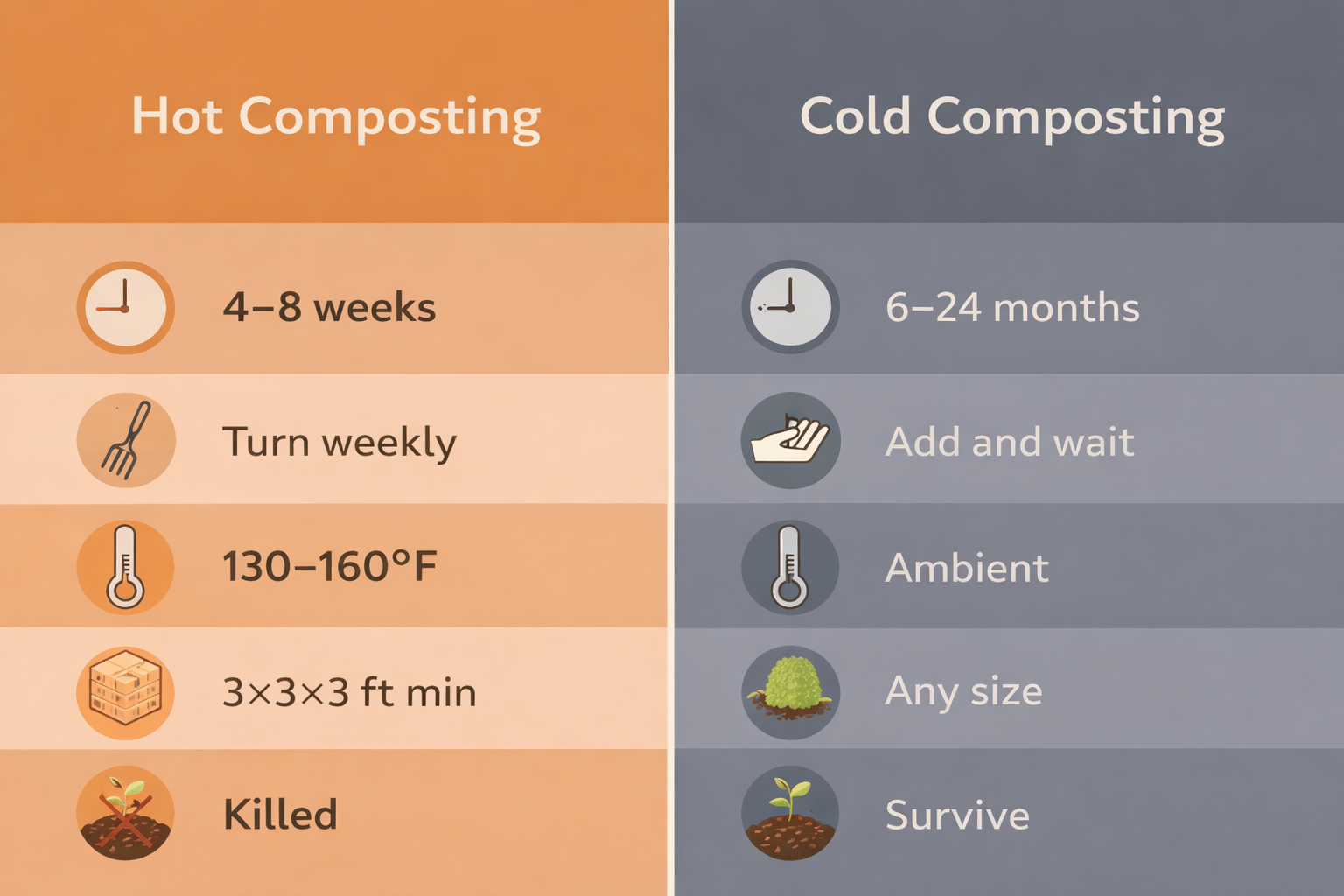
What’s Actually Happening in Each Pile
The difference isn’t just speed. It’s biology.
Hot composting is driven by thermophilic bacteria, microorganisms that thrive at high temperatures. When a pile reaches 113°F (45°C), these heat-loving bacteria take over and break down organic matter rapidly. The target window for active hot composting is 130–160°F (55–71°C). Within that range, decomposition accelerates, weed seeds lose viability, and pathogens are destroyed. According to the Cornell Waste Management Institute, maintaining 131°F (55°C) for three consecutive days is enough to eliminate common pathogens including E. coli and Salmonella.
Above 160°F (71°C), the pile can overheat and start killing the beneficial organisms doing the work. Turning the pile at that point brings temperatures back into range and reintroduces oxygen.
Cold composting relies on mesophilic bacteria, which operate at ambient temperatures. Slower, but steady. The end product is the same finished compost. The pile just takes months rather than weeks to get there. The threshold where thermophilic activity overtakes mesophilic activity is consistently identified at 113°F (45°C). Below that line, decomposition continues but at a fraction of the pace.
One practical difference: cold piles don’t reliably reach temperatures needed to kill weed seeds or pathogens. If your pile contains material from a diseased plant or anything with mature seed heads, cold composting won’t neutralize the problem.
Hot Composting: What It Takes
Hot composting is an active system. It rewards attention and punishes neglect.
The first requirement is pile size. The minimum for a pile that holds heat is 3x3x3 feet (roughly 1 cubic yard / 0.76 m³). A pile smaller than that loses heat faster than microbial activity generates it. It warms up for a day, then cools down. Below that threshold, you’re effectively cold composting whether you intend to or not.
The second requirement is carbon-to-nitrogen balance. The target ratio is roughly 25–30 parts carbon to 1 part nitrogen by weight. In practice: two to three parts dry brown material (leaves, cardboard, straw) to one part green material (grass clippings, food scraps, fresh garden waste). A pile that’s too nitrogen-heavy turns wet and smells. Too carbon-heavy and it stalls completely.
Moisture matters throughout. The pile should feel like a wrung-out sponge. Squeeze a handful: a few drops of water, not a stream. Too wet and it goes anaerobic. Too dry and microbial activity slows.
Turning frequency drives heat retention. Every 3–7 days is the standard. Each turn reintroduces oxygen and moves cooler outer material into the hot center where decomposition is fastest. With consistent management, finished compost in 4–8 weeks is realistic.
📝 Editor’s note: The simplest system for hot composting: leave the thermometer in the pile permanently and turn as often as you reasonably can. The thermometer tells you when the pile needs attention: above 160°F (71°C), turn immediately; below 100°F (38°C), turn and check your carbon:nitrogen balance. If you have a tumbler, a few spins every couple of days is enough. Most people who give up on hot composting do so because they lost track of where the pile was in the cycle. A thermometer you never remove fixes that.
For the structural setup, our compost pile building guide covers dimensions, layering ratios, and the setup mistakes that keep piles from heating up in the first place.
If turning a pile every few days sounds like more work than you want, a compost tumbler removes most of that labor. The sealed drum retains heat better than an open pile, and a single handle turn does what a pitchfork takes 20 minutes to accomplish.
Cold Composting: What It Actually Is
Cold composting is not a lesser version of hot composting. It’s a different trade-off: almost no effort, much more time.
You add organic material to a pile or bin over time. Mesophilic bacteria and fungi break it down at ambient temperatures. Six months to two years for finished compost, depending on what you add and the climate. No turning required. No pile size minimum. No thermometer.
What to avoid: diseased plant material, weeds with mature seed heads, meat, dairy, and cooked food. Not because cold composting can’t process organic matter, but because the pile won’t reach the temperatures needed to neutralize pathogens or render seeds non-viable. Everything else that goes into a hot pile is fine in a cold pile.
Cold piles are more prone to going anaerobic if you add a large volume of wet material at once. Nitrogen-heavy inputs with no browns mixed in create the conditions for smell. The fix is always the same: add dry carbon material and work it through. Our compost smell guide covers the specific causes and corrections in detail.
For a cold pile, you need containment more than engineering. Any open bin keeps material in place, manages appearance, and discourages pests. Our compost bin roundup covers the options from basic open frames to purpose-built designs.
If you compost in a backyard and want to understand the full seasonal cycle, backyard composting goes deeper on managing a cold pile through winter and into spring.
Which Method Should You Use?
The answer depends on three things: how much time you have to tend the pile, what you’re composting, and whether weed seeds or pathogens are a concern.
| Your situation | Method |
|---|---|
| Large batch of yard waste, willing to turn weekly | Hot composting |
| Small amounts added gradually, low-effort preference | Cold composting |
| Diseased plants or material with weed seeds | Hot composting only |
| Meat, dairy, or cooked food | Bokashi |
| Apartment, limited outdoor space, year-round kitchen scraps | Worm bin |
If your kitchen waste includes meat, dairy, or cooked food, neither pile method handles it reliably. Bokashi fermentation is designed for exactly that input. The fermented output can be buried directly in soil or added to a compost pile to finish breaking down.
For apartment composting or anyone who wants finished vermicompost without maintaining a pile outdoors, a worm bin works indoors, processes kitchen scraps continuously, and produces concentrated castings.
FAQ
How hot does a compost pile need to get?
The target range for hot composting is 130–160°F (55–71°C). Below 130°F (55°C), decomposition slows and weed seeds may survive. Above 160°F (71°C), the pile can overheat and begin killing beneficial organisms. A compost thermometer is the only reliable way to know where your pile stands.
How long does hot composting take?
With consistent turning every 3–7 days and a properly balanced pile, 4–8 weeks is a realistic timeline. Piles that cool too quickly, are too wet, or are too dry take longer. Cold weather slows the process; heat speeds it up.
Can I cold compost in winter?
Yes. Microbial activity slows below 50°F (10°C) but doesn’t stop entirely. The pile goes dormant and picks back up in spring. Insulating with straw bales or a bin cover extends the active season. Most cold composters add material through winter and harvest what has broken down in spring.
What’s the minimum pile size for hot composting?
University of Illinois Extension puts the minimum at 3x3x3 feet (roughly 1 cubic yard / 0.76 m³). Smaller piles lose heat faster than microbes generate it. If you’re working with less material than that, cold composting is more practical than trying to force a small pile to heat up.
Can you hot compost in a bin?
Yes, with the right bin. Compost tumblers are purpose-built for hot composting: the sealed drum retains heat, and turning requires only a few seconds of effort. Enclosed composters with insulated walls also retain heat well. Open bins work if the pile is large enough, but heat loss through the sides is harder to control.
Do I need to turn a cold compost pile?
No turning is required, but occasional mixing helps. A few turns per year speeds up decomposition and prevents the outer layers from staying dry while the center breaks down. It also makes it easier to harvest finished compost from the bottom while adding fresh material on top.
What can’t you put in a cold compost pile?
Avoid diseased plant material, weeds with mature seeds, meat, fish, dairy, cooked food with oils, and pet waste. Cold composting temperatures don’t reliably neutralize pathogens or kill weed seeds. Fruit and vegetable scraps, coffee grounds, eggshells, dry leaves, cardboard, and grass clippings are all fine.
You might also like
Free for beginners
Get the Free Composting Starter Kit
5-day email course + printable guide + our top product picks. Everything you need to start composting confidently.
Get Free AccessNo spam. Unsubscribe any time.