Why Does My Compost Smell Bad? (And How to Fix It)
If you’re wondering why your compost smells bad, it almost always comes down to one specific type of smell, and that smell tells you exactly what went wrong. Ammonia, rotten eggs, sour funk: each one has a different cause and a different fix.
I’ve been composting for years and gone through every possible stage of smelly pile: ammonia clouds that hit you when you lift the lid, swamp-water stench from a pile that sat too wet all winter, and that strange sweet-sour smell you sometimes get in late summer. Some of these are bad. Some are fine. Knowing the difference saves you a lot of pointless turning. If you’re still setting up your system, our beginner’s guide to composting covers the fundamentals. But if your pile already stinks, start here.
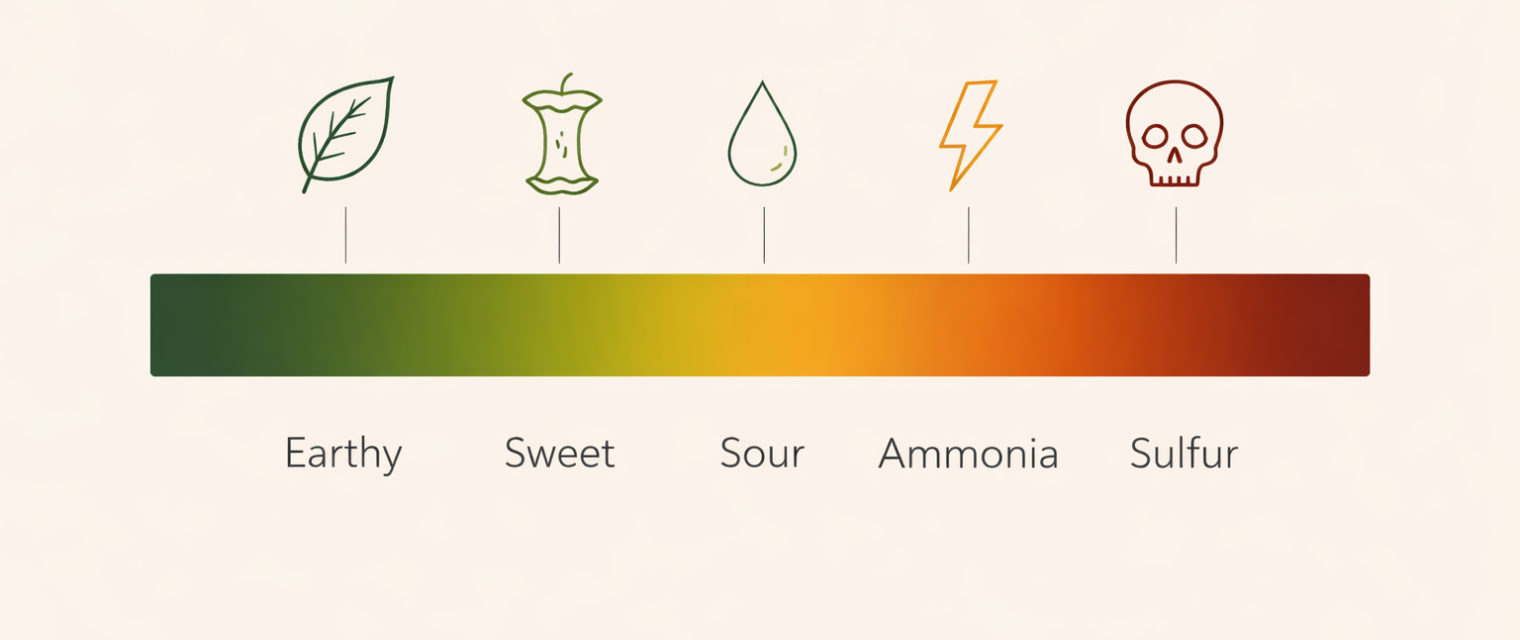
Earthy and Damp: What Healthy Compost Smells Like
Before we get into problems: a working compost pile has a smell too, and it’s worth knowing what it is so you don’t fix something that isn’t broken. Healthy compost smells like a forest floor after rain: earthy, damp, slightly mushroomy. It’s not a strong smell. You have to lean in to notice it.
If that’s what you’re getting, your pile is fine. The microbes are doing their job, the moisture and airflow are balanced, and you don’t need to change anything. This is the baseline. Everything below is a departure from it.
Sweet or Sour: Usually Fine
A faintly sweet smell, or something slightly fermented and fruity: this is generally not a problem. You might notice it when the pile is very active and warm in the center, or when you’ve added a lot of fruit scraps.
Some people mistake this for a problem because it’s unfamiliar. But sweet-smelling compost is usually just fast, healthy decomposition. If the pile is warm, the material is breaking down, and there’s no rotten-egg sulfur underneath the sweetness. You’re fine. Leave it alone.
The sour version (like vinegar or overripe fruit) can sometimes indicate the pile is slightly acidic or beginning to go anaerobic in pockets. Worth turning it once and adding some browns. But it’s not an emergency.
Ammonia: Too Much Green, Not Enough Brown
Sharp, eye-watering, kind of like a barn in summer: that’s ammonia. It means your pile has too much nitrogen-rich material (greens: food scraps, fresh grass clippings, coffee grounds) and not enough carbon (browns: cardboard, dry leaves, straw, paper).
The nitrogen has nowhere to go and it off-gasses as ammonia. You’re literally losing fertilizer into the air.
Fix: Add browns aggressively. Tear up cardboard boxes, grab a bag of dry leaves if you saved any, shred some newspaper. Mix it in thoroughly, not just on top. Then water the pile slightly if it feels dry, since the bacteria that process nitrogen need moisture to work. The smell should start to fade within a day or two.
The ratio people quote is 25–30 parts carbon to 1 part nitrogen by weight, but in practice that’s impossible to measure. A simpler rule: add browns every time you add food scraps, roughly equal volumes. If you’re composting a lot of grass clippings, triple the browns. This is one of the most common questions on r/composting, and the answer is almost always the same: more cardboard.
📝 Editor’s note: The nitrogen ratio problem shows up as smell before anything else. Most complaints from new composters come from batches that started with too many kitchen scraps and not enough dry browns. If you catch the ammonia smell early, a single round of shredded cardboard mixed in thoroughly is usually enough to turn it around within 48 hours.
Rotten Eggs: Anaerobic Conditions
This is the worst smell in composting. Sulfurous, swampy, like something genuinely rotting. It means your pile has gone anaerobic: there’s no oxygen reaching the bacteria, so different microbes have taken over. They work slowly and produce hydrogen sulfide as a byproduct.
Three things cause it: the pile is too wet, it’s too compacted, or it’s missing structure (all food scraps, no chunky browns to create air pockets).
Fix: Turn the pile immediately if you can. Break it apart and mix in dry, coarse material: wood chips, torn cardboard, straw. The goal is to get air moving through it. If the pile is soggy, move it somewhere with better drainage or cover it to stop more rain getting in. Don’t water it again until it’s dry to the touch a few inches in.
One turn usually knocks out the smell within 24–48 hours. If it comes back, your pile is probably too wet structurally. Add more coarse browns and reconsider the location.
The Smell That’s Hardest to Fix
Meat, dairy, and cooked food in a standard outdoor pile. These materials decompose much more slowly than plant matter, attract pests, and produce persistent foul smells even in an otherwise healthy pile.
If you want to compost these things, and there’s no reason you shouldn’t. You need either a bokashi system or a sealed, pest-proof bin that can handle them. Bokashi ferments food anaerobically with beneficial microbes and doesn’t smell like rot; it smells pickled, which is different. You can find a good bokashi kit here if that’s something you want to try.
For a standard pile: keep meat and dairy out entirely. If you’ve already added some, bury it deep in the center, cover with browns, and accept that you’ll have some smell for a while. There’s no shortcut.
Quick diagnosis, find your smell:
Healthy compost. No action needed.
Active decomposition. Usually fine. Just monitor.
Early anaerobic pockets. Turn once + add browns.
Too much nitrogen. Add browns aggressively + mix.
Anaerobic: no oxygen. Turn immediately + restructure pile.
Why Does My Compost Smell Bad Even When I Do Everything Right?
Sometimes a pile smells bad even when you’ve balanced your greens and browns, you’re turning regularly, moisture looks right. A few less obvious causes:
Location matters more than most guides admit. A pile against a fence with no airflow, or in a depression where water pools after rain, will have chronic smell issues regardless of what you do. The fix is moving it, somewhere with partial sun, on ground that drains, ideally with airflow on at least three sides.
Pile size. A pile that’s too small (less than a cubic yard) won’t heat up and may stay in an awkward half-decomposed state that smells musty. Too big and the center goes anaerobic from weight alone. Three feet cubed is a useful target.
Seasonal timing. In late summer when it’s hot and dry, an active pile can smell stronger even when nothing is wrong. It’s producing more volatile compounds as decomposition speeds up. A bit more moisture and a turn usually balances it out.
If you’re troubleshooting from scratch and want a more systematic approach, the guide to building a compost pile covers the setup in more detail, including why structure at the base matters more than most people think.
Most smell problems are fixable in under an hour. Figure out which category you’re in, make one targeted change, and give it a couple of days. A well-built pile shouldn’t smell like anything worse than earthy and slightly sweet.
FAQ
Is it normal for compost to smell?
Healthy compost has a mild, earthy smell, like forest floor after rain. If it smells like anything stronger than that, something is off. A faint sweet smell during active decomposition is fine. Ammonia, sulfur, or rotten-egg smells mean the pile needs attention.
Why does my compost smell like ammonia?
Too much nitrogen (greens) and not enough carbon (browns). The excess nitrogen off-gasses as ammonia. Fix it by adding cardboard, dry leaves, or shredded newspaper, roughly equal volume to whatever greens you’ve added. The smell usually fades within a day or two.
Why does my compost smell like rotten eggs?
That sulfur smell means your pile has gone anaerobic: no oxygen is reaching the microbes. The usual causes: too wet, too compacted, or not enough bulky browns to create air pockets. Turn the pile immediately and mix in coarse, dry material like wood chips or torn cardboard.
How do I fix smelly compost fast?
Identify the smell first. Ammonia = add browns and mix. Rotten eggs = turn the pile and add coarse material for airflow. Sour/vinegar = one good turn and some browns. Most compost smells are fixable in under an hour, and the improvement shows within 24–48 hours.
Can I compost meat and dairy without it smelling?
Not in a standard open pile. Meat and dairy decompose slowly, attract pests, and produce persistent odors. If you want to compost these materials, use a bokashi system: it ferments food anaerobically without the rot smell.
How long does it take for compost smell to go away after fixing it?
Ammonia and sour smells usually fade within 1–2 days after adding browns and turning. Rotten-egg smell from anaerobic conditions can take 2–3 days after a thorough turn. If the smell persists beyond 3–4 days, the underlying cause hasn’t been fully addressed. Check moisture, compaction, and drainage.
Does compost attract rats, flies, or other pests?
A well-managed pile rarely attracts rodents. Exposed food scraps on top are the main attractant. Always bury fresh food scraps under a layer of browns. Fruit flies are common in warm weather but harmless. If you’re seeing rats, switch to a closed bin or stop adding cooked food and grains.
Should I cover my compost pile to reduce smell?
A layer of browns (dry leaves, straw, cardboard) on top acts as a natural biofilter and significantly reduces odor. A physical cover or tarp helps keep rain out and prevents the pile from getting too wet, which is the most common cause of persistent smell problems. Just make sure air can still circulate.
You might also like
Free for beginners
Get the Free Composting Starter Kit
5-day email course + printable guide + our top product picks. Everything you need to start composting confidently.
Get Free AccessNo spam. Unsubscribe any time.