What Is Bokashi Composting? (And Why It Handles What Your Compost Pile Won’t)
Here’s something most composting guides won’t tell you: meat, fish, dairy, cooked food, bones. Standard composting methods reject all of it. For households that cook at home regularly, that’s most of the food waste going straight to the trash. Bokashi composting was developed specifically to close that gap, and the science behind it is older and more proven than most people realize.
The word bokashi (ぼかし) is Japanese for “fermented organic matter.” The method traces back centuries in East Asian agriculture, but the modern version was formalized in the 1980s by Dr. Teruo Higa, a horticulture professor at the University of the Ryukyus in Okinawa. His research into Effective Microorganisms (EM), specific combinations of lactic acid bacteria, yeasts, and phototrophic bacteria, became the foundation of every bokashi system sold today.
What makes bokashi fundamentally different from every other home composting method isn’t the container. It’s the biology.
📝 Editor’s note: We ran a bokashi bin alongside a standard compost pile for a full year. The biggest surprise wasn’t the speed. It was what we stopped throwing away. Meat scraps, leftover pasta, the cheese rinds we’d been tossing in the trash for years. Once those went into the bokashi bin, the amount of actual garbage we produced dropped noticeably. The system is less intuitive than a compost pile at first, but the learning curve is about two batches.
The Science Behind Bokashi Fermentation
Traditional composting is aerobic decomposition: microorganisms break down organic matter in the presence of oxygen. This works well for plant material, but proteins and fats overwhelm the process, producing hydrogen sulfide and ammonia, which is why your compost pile smells terrible when meat gets in.
Bokashi is anaerobic fermentation, a completely different biological pathway. In a sealed, oxygen-free environment, lactic acid bacteria (the same Lactobacillus species that produce yogurt, sauerkraut, and kimchi) convert organic matter through lactic acid fermentation. The pH drops rapidly to around 3.5-4.0, effectively pickling the food waste and suppressing the putrefactive bacteria that cause odor and attract pests.
This is not theoretical. Research published in the Journal of Material Cycles and Waste Management has demonstrated that bokashi pre-compost, when buried in soil, increases microbial biomass and accelerates nutrient cycling compared to raw food waste. A 2020 study in Waste Management found that bokashi-treated food waste reached stable compost in 30% less time than untreated material when added to aerobic systems.
Dr. Higa’s original EM formulation, a consortium of roughly 80 species of beneficial microorganisms, remains the basis for most commercial bokashi bran. The key players are Lactobacillus casei and Lactobacillus plantarum, supported by yeasts (Saccharomyces cerevisiae) that produce enzymes to break down complex carbohydrates, and phototrophic bacteria that metabolize toxic byproducts.
How Bokashi Composting Works (Step by Step)
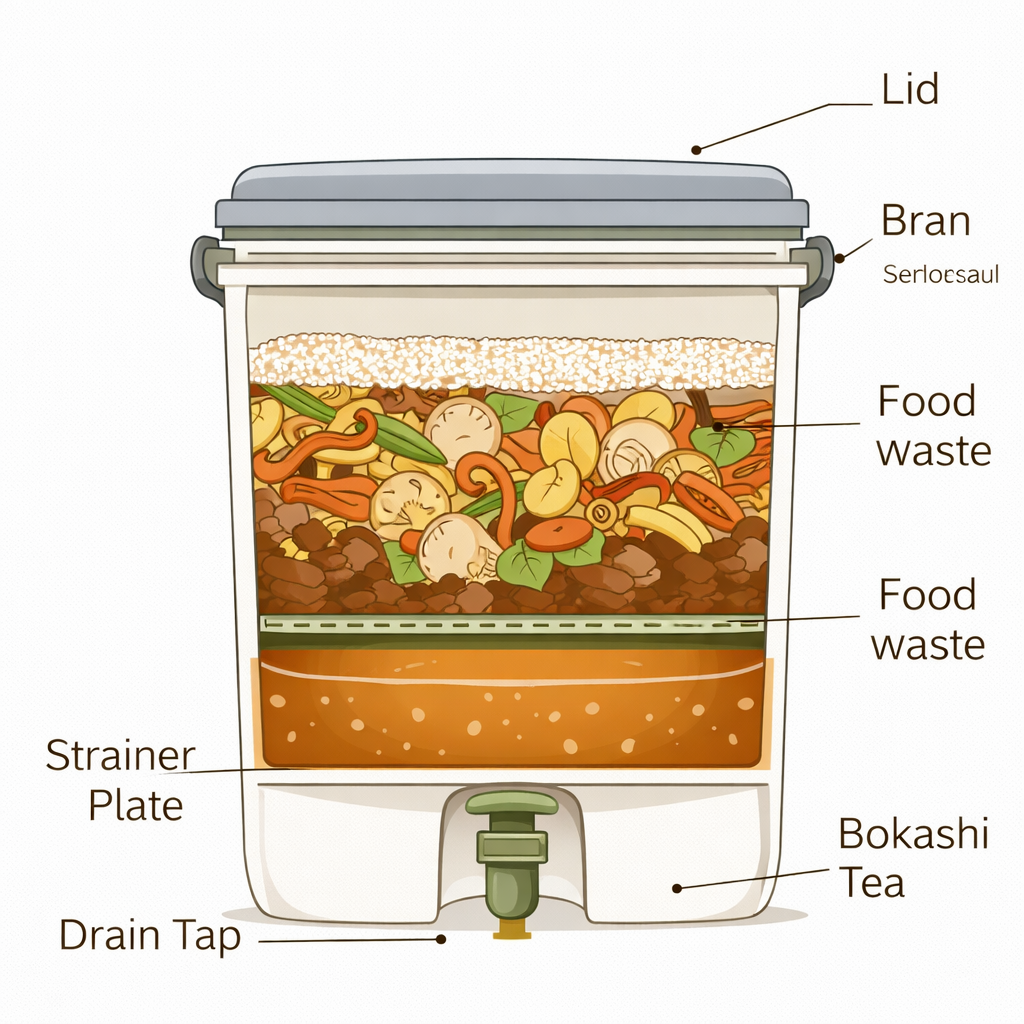
The process requires two things: a bokashi bin (an airtight bucket with a drainage tap) and bokashi bran (wheat bran or sawdust inoculated with EM cultures).
Step 1: Layer and seal. Add food scraps to the bin, a few inches at a time. Sprinkle a tablespoon of bokashi bran over each layer. Press everything down firmly with a masher or plate to eliminate air pockets. Close the lid tightly.
Step 2: Repeat. Each time you add scraps, add bran, press, seal. The bin fills over 2-4 weeks depending on your household size.
Step 3: Drain the tea. Every 2-3 days, open the tap at the bottom and drain the liquid. This bokashi tea, rich in beneficial microbes, can be diluted 1:100 with water and used as plant fertilizer, or poured undiluted down slow drains to break down buildup.
Step 4: Ferment. Once the bin is full, seal it completely and leave it undisturbed for two weeks. The lactic acid fermentation does its work. You’ll know it’s successful by the sweet-sour, pickle-like smell when you open it.
Step 5: Finish in soil. The result isn’t finished compost. It’s fermented pre-compost. Bury it in a garden bed, add it to a compost pile, or mix it into a large container of soil. It breaks down completely in 2-4 weeks. After that, the soil is ready for planting.
What You Can (and Can’t) Put in a Bokashi Bin
Yes, almost all organic kitchen waste: fruit and vegetable scraps, meat, fish, shellfish, dairy, eggs, bread, pasta, rice, cooked food, coffee grounds, tea bags, small bones, cheese, oil in small amounts.
No: liquids (soup, juice: they flood the system), large bones, non-organic waste (plastic, metal, glass), excessive amounts of oil, pet waste.
This is where bokashi outperforms every other home method. A standard compost bin handles maybe 60% of kitchen waste. An electric composter handles most food but not bones or large volumes. Bokashi handles virtually everything organic.
Bokashi vs Traditional Composting
What they accept: A cold compost pile takes vegetable scraps, garden waste, and paper. A hot pile is more flexible but requires volume and careful carbon-nitrogen balance. Bokashi takes everything including meat, dairy, and cooked food, with no restrictions.
Where they live: Piles and bins need outdoor space. Bokashi lives under your kitchen sink. If you’re composting in an apartment, bokashi is one of the few methods that works entirely indoors during the fermentation phase.
Speed: Cold pile: 6 months to 2 years. Hot pile: 6 to 8 weeks. Bokashi: 4 to 6 weeks total (2 weeks fermentation + 2-4 weeks soil finishing).
Cost: Once set up, a compost pile costs nothing. Bokashi bran is an ongoing expense, roughly $15-25 for a 2 lb bag that lasts 1-2 months.
The practical reality: Many experienced composters run both systems: bokashi for kitchen waste including the proteins and fats nothing else accepts, and an outdoor pile for yard trimmings and garden material. They complement each other perfectly.
The Honest Trade-Off
Bokashi has one real limitation: it doesn’t finish alone. The fermented pre-compost needs somewhere to go: a garden bed, a compost pile, or at minimum a large pot filled with soil. If you have zero outdoor access and no space for a soil container, plan that step before you invest.
It also has an ongoing cost. Bran gets used up at roughly 1-2 lbs per month. A well-maintained outdoor pile costs nothing to run. That’s worth knowing upfront, not as a dealbreaker, but as a realistic expectation.
Getting Started
Two bins is the standard setup: fill one while the other ferments, no downtime. Most purpose-built kits include both bins, bran, a masher, and a drainage cup. Look for a kit with quality bran (the microbial culture matters more than the bucket design) and a leak-free spigot.
We analyzed 1,900+ verified owner reviews to find which kits actually hold up. See our best bokashi composting kits roundup for specific recommendations.
FAQ
Does bokashi composting smell?
When sealed, no smell at all. When you open the lid, you’ll notice a sweet-sour, pickle-like aroma: that’s the lactic acid fermentation working correctly. If it smells putrid or rotten, something went wrong: usually too little bran or a compromised seal letting oxygen in.
Is bokashi composting actually composting?
Technically, no: it’s fermentation, not decomposition. The bokashi process preserves organic matter in an acidified state rather than breaking it down. True decomposition happens in the second stage, when the fermented material is buried in soil and aerobic microorganisms finish the job. Some purists object to calling it “composting,” but the end result (nutrient-rich soil amendment) is the same.
How long does bokashi composting take from start to finish?
About 4-6 weeks total. The fermentation phase takes 2 weeks after the bin is full. Then the pre-compost needs 2-4 weeks in soil to fully break down. After that, the soil is ready for planting.
Can I use bokashi in an apartment?
Yes, the fermentation stage is completely indoor-friendly. No odor, no pests, no outdoor space needed. The challenge is the finishing step: you need somewhere to bury the pre-compost. Options include a large planter filled with soil, a community garden, or a worm bin. See our apartment composting guide for details.
What is bokashi tea and is it safe for plants?
Bokashi tea is the liquid that drains from the bin during fermentation. It’s rich in lactic acid bacteria and nutrients. Diluted 1:100 with water, it’s an effective plant fertilizer. Don’t store it: the anaerobic bacteria go bad when exposed to air. Use it within 24 hours of draining.
Do I need special bran or can I make my own?
You can make your own by inoculating wheat bran with an EM-1 concentrate (available on Amazon), molasses, and water, then fermenting it for 2 weeks in a sealed bag. Most people find buying pre-made bran easier. A 2 lb bag costs $15-25 and lasts 1-2 months. The quality of the microbial culture matters significantly for reliable fermentation.
What happens if my bokashi fails? How do I know?
A failed bokashi batch smells putrid (like rotting food, not pickles), grows black or blue-green mold, or shows no signs of fermentation after two weeks. White mold is actually a good sign: it indicates active fungal activity. Failures are usually caused by too little bran, an air leak in the lid, or adding too much liquid. The fix: add more bran, check the seal, and drain the tap more frequently.
You might also like
Free for beginners
Get the Free Composting Starter Kit
5-day email course + printable guide + our top product picks. Everything you need to start composting confidently.
Get Free AccessNo spam. Unsubscribe any time.